
P_E_T_E_R
Aktives Mitglied
Das ging aber schnell, gerade mal drei Monate seit dem Beginn des routinemäßigen Beobachtungsprogramms ist dem neuen Vera C. Rubin Observatory schon ein bedeutender Fang gelungen:
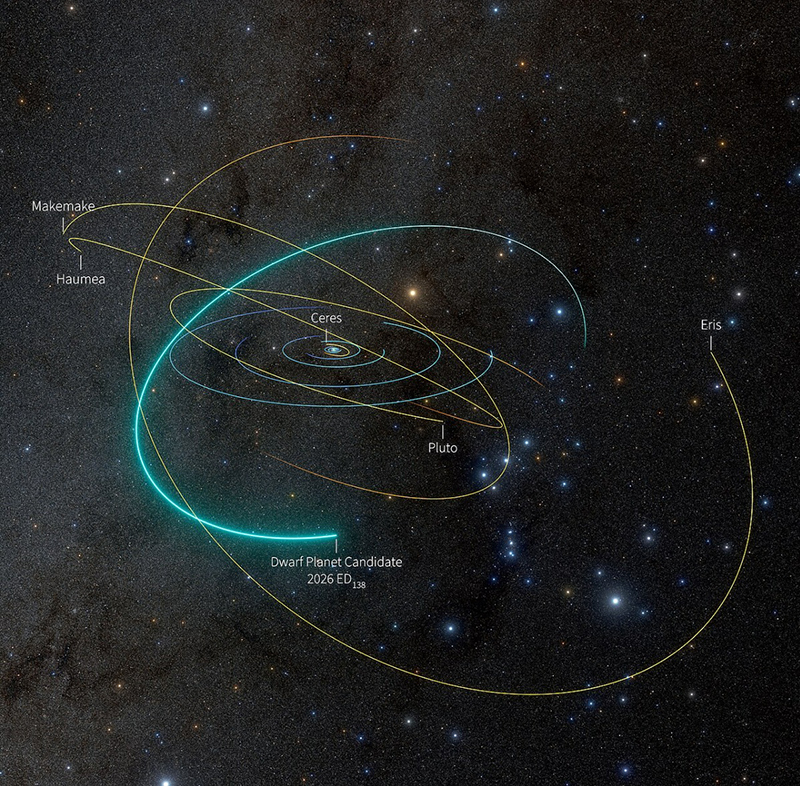
2026 ED138
Vera C. Rubin Observatory Reveals Its First Dwarf Planet Candidate in Our Solar System
2026 ED138 3D orbit (YouTube)
A New Dwarf Planet (Probably) Spotted Beyond Pluto
Gruß, Peter
__________________________________________________________________________________________________________________________________________________
(*) Laut MPC hat 2026 ED138 eine visuelle Magnitude von ca. 20, liegt also durchaus im Bereich größerer Amateuroptiken.
2026 ED138
2026 ED138 is a trans-Neptunian object and possible dwarf planet discovered in 2026 using data from the Vera C. Rubin Observatory, and identified in pre-discovery data taken with the Dark Energy Survey's DECam camera. As of October 2026, it is at a distance of roughly 46 AU from the Sun. Its size is estimated between 600 and 1500 kilometers.
Vera C. Rubin Observatory Reveals Its First Dwarf Planet Candidate in Our Solar System
Today, MPC announced the discovery in a Minor Planet Electronic Circular. Mario Jurić, faculty at the University of Washington and Rubin Solar System Lead Scientist, and Holman presented the results at a press conference at the 58th Annual Division for Planetary Sciences (DPS) meeting in Spokane, Washington.
On the evening of 13 October, Holman was running data collected by Rubin earlier in 2026 through a search code he developed with CfA colleague Kevin Napier. The code is built to look at billions of detections of moving objects, compare them, and find the detections that correspond to the same object. Using this method, Holman uncovered ED138, and he immediately noticed that its brightness and distance indicated that it is unusually large.
2026 ED138 3D orbit (YouTube)
Not all TNOs are considered dwarf planet candidates, with the distinction being in the size and shape of the object. To be a dwarf planet an object needs to be massive enough for its own gravity to pull it into a round shape. Based on ED138’s distance, brightness and estimated surface reflectivity (albedo), the team estimates that its size is between 600 and 1500 kilometers, and icy bodies this large are expected to be round.
This preliminary analysis places ED138 among the largest dwarf planet candidates ever discovered beyond Neptune, though observations in the infrared are needed to constrain its exact size and confirm its nature as a dwarf planet. If confirmed, ED138 would join the five dwarf planets recognized by the International Astronomical Union (IAU): Pluto, Ceres, Eris, Haumea, and Makemake.
A New Dwarf Planet (Probably) Spotted Beyond Pluto
Operated by the National Science Foundation and the United States Department of Energy, Rubin repeatedly scans the night sky from a mountaintop in Chile. Dr. Jurić said the observatory has already discovered about 2,300 objects beyond Pluto. “That’s increasing the known population by about 50 percent,” he said.
This newest one, with the temporary designation of 2026 ED138, is the biggest of the bunch.
“In some senses, it’s not a big surprise,” Dr. Holman said. “But that doesn’t mean it’s not exciting.”
Indeed, simply spotting ED138 did not require a world-class telescope like Rubin. "It is, in fact, bright enough that very capable amateurs can find it with their equipment," Dr. Holman said. (*)
If it turns out that ED138 possesses a moon - common for many of these objects in the outer solar system - the moon’s orbital period would provide a measurement of both objects’ total mass.
Astronomers could also learn more based on what they do not see. ED138 is currently passing through a crowded part of the sky where it is likely to pass in front of distant stars in the Milky Way galaxy, briefly blocking out their starlight. That will provide better estimates of ED138’s size and could even offer hints about whether it possesses an atmosphere.
Gruß, Peter
__________________________________________________________________________________________________________________________________________________
(*) Laut MPC hat 2026 ED138 eine visuelle Magnitude von ca. 20, liegt also durchaus im Bereich größerer Amateuroptiken.
Zuletzt bearbeitet: