
P_E_T_E_R
Aktives Mitglied
Der Saturnmond Enceladus besitzt offenbar einen unter dem oberflächlichem Eisschild verborgenen Ozean aus salzigem Wasser. Darauf deuten jedenfalls die von Cassini untersuchten Kryogeysire hin.
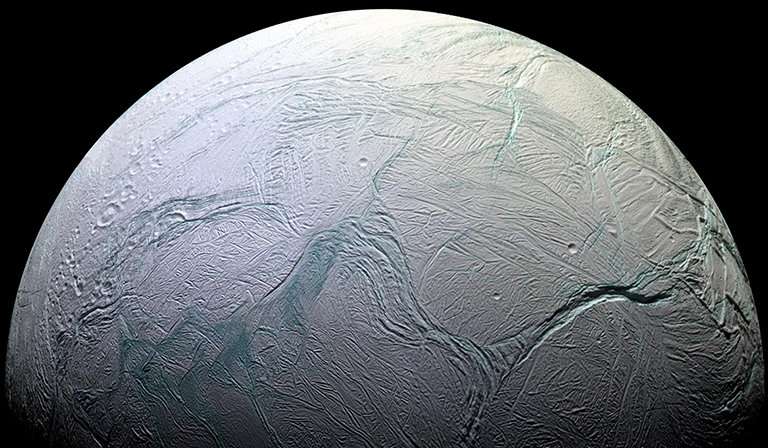
Saturn's moon Enceladus. Credit: NASA
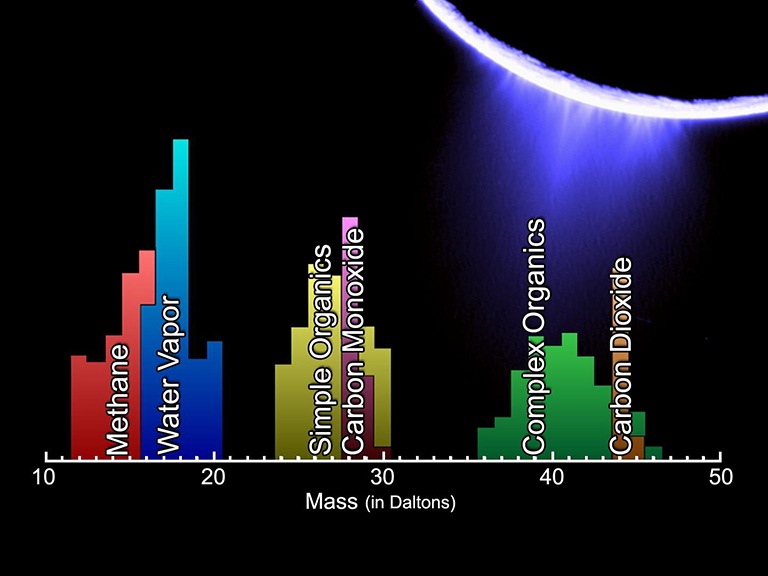
The chemical composition of Enceladus's plumes
NASA/JPL/SwRI
Neue Laboruntersuchungen an der FU-Berlin deuten darauf hin, dass beim Ausfrieren der Geysirtröpfchen bereits eine weitgehende Differenzierung der chemischen Bestandteile stattfindet, was den Nachweis von Biosignaturen am Enceladus bei zukünftigen Missionen wesentlich erleichtern würde:
Great news from Saturn's moon Enceladus in the search for life in space
Cassini CDA observes compositional segregation of Enceladus’ ice grains from slow freezing and fragmentation of oceanic spray
Enceladus-like geochemistry fuels methanogenesis under extreme CO2 limitation
Gruß, Peter
Saturn's moon Enceladus. Credit: NASA
The Cassini spacecraft flew through the southern plumes on several occasions to sample and analyse their composition. The INMS instrument detected mostly water vapour, as well as traces of molecular nitrogen, carbon dioxide, and trace amounts of simple hydrocarbons such as methane, propane, acetylene and formaldehyde. Cassini also found traces of simple organic compounds in some dust grains, as well as larger organics such as benzene and complex macromolecular organics as large as 200 atomic mass units, and at least 15 carbon atoms in size.
Further analysis in 2019 was done of the spectral characteristics of ice grains in Enceladus's erupting plumes. The study found that nitrogen-bearing and oxygen-bearing amines were likely present, with significant implications for the availability of amino acids in the internal ocean. The researchers suggested that the compounds on Enceladus could be precursors for "biologically relevant organic compounds"
The chemical composition of Enceladus's plumes
NASA/JPL/SwRI
Neue Laboruntersuchungen an der FU-Berlin deuten darauf hin, dass beim Ausfrieren der Geysirtröpfchen bereits eine weitgehende Differenzierung der chemischen Bestandteile stattfindet, was den Nachweis von Biosignaturen am Enceladus bei zukünftigen Missionen wesentlich erleichtern würde:
Great news from Saturn's moon Enceladus in the search for life in space
Cassini CDA observes compositional segregation of Enceladus’ ice grains from slow freezing and fragmentation of oceanic spray
Enceladus-like geochemistry fuels methanogenesis under extreme CO2 limitation
Gruß, Peter