
P_E_T_E_R
Aktives Mitglied
Während über das Extremly Large Telescope (ELT) und das Thirty Meter Telescope (TMT) hier schon öfter berichtet wurde, ist das derzeit drittgrößte Teleskopprojekt, nämlich das Giant Magellan Telescope (GMT) bislang allenfalls beiläufig erwähnt worden. Dabei macht das GMT gute Fortschritte, im Unterschied zum TMT, welches wegen der Querelen über den vorgesehenen Standort in Hawaii nicht so recht vorankommt.
Sixth mirror cast for Giant Magellan Telescope
The Giant Magellan Telescope announces fabrication of the sixth of seven of the world's largest monolithic mirrors. The process of casting the giant mirror at Arizona's Richard F. Caris Mirror Lab involves melting nearly 20 tons of high-purity, low-expansion, borosilicate glass (called E6 glass) into the world's only spinning furnace designed to cast giant mirrors for telescopes. At the peak of the melting process, the furnace spins at five revolutions per minute, heating the glass to 1,165 degrees Celsius for approximately five hours until it liquefies into the mold. The peak temperature event is called "high fire" and will occur on March 6, 2021. The mirror then enters a one month annealing process where the glass is cooled while the furnace spins at a slower rate in order to remove internal stresses and toughen the glass. It takes another 1.5 months to cool to room temperature. This "spin cast" process gives the mirror surface its special parabolic shape. Once cooled, the mirror will be polished for two years before reaching an optical surface precision of less than one thousandth of the width of a human hair.
Während das optische Konzept beim ELT und beim TMT dem der Keck Teleskope mit Primärspiegeln aus einer größeren Zahl von hexagonalen Segmenten ähnelt, besteht der Primärspiegel vom GMT aus nur sieben gewaltigen Einzelspiegeln von jeweils 8,4 m Durchmesser. Diese Spiegel werden nach dem von Roger Angel entwickelten Spin-Casting Verfahren hergestellt. Dabei rotiert die Glasschmelze und bildet so bereits die angestrebte Form eines Rotationsparaboloids, was den anschließenden Schleif und Poliervorgang wesentlich vereinfacht. Klingt einfach, ist bei großen Spiegeln mit einem Durchmesser von 8,4 m aber sehr aufwändig. Allein der langsame Abkühlvorgang dauert ein halbes Jahr!
The casting of the first mirror, in a rotating furnace, was completed on November 3, 2005, but the grinding and polishing were still going on 6½ years later when the second mirror was cast, on 14 January 2012. A third segment was cast in August 2013, and the fourth in September 2015. The casting of each mirror uses 20 tons of E6 borosilicate glass and takes about 12–13 weeks. After being cast, they need to cool for about six months.
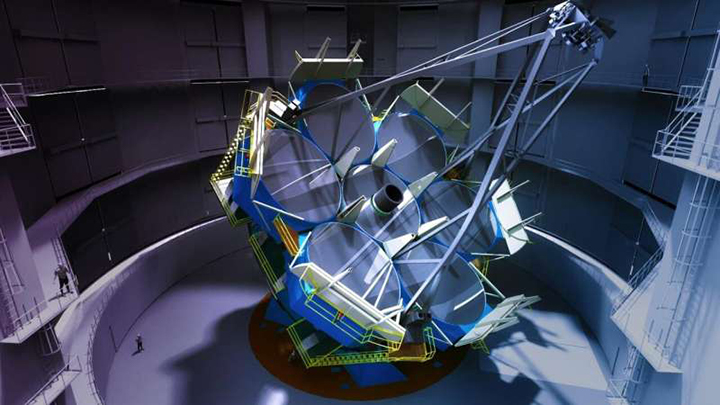
Credit: Giant Magellan Telescope - GMTO Corporation
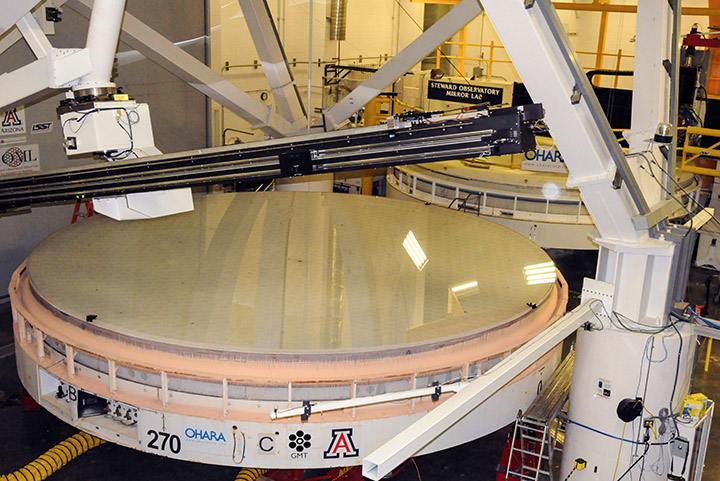
Credit: Steward Mirror Lab
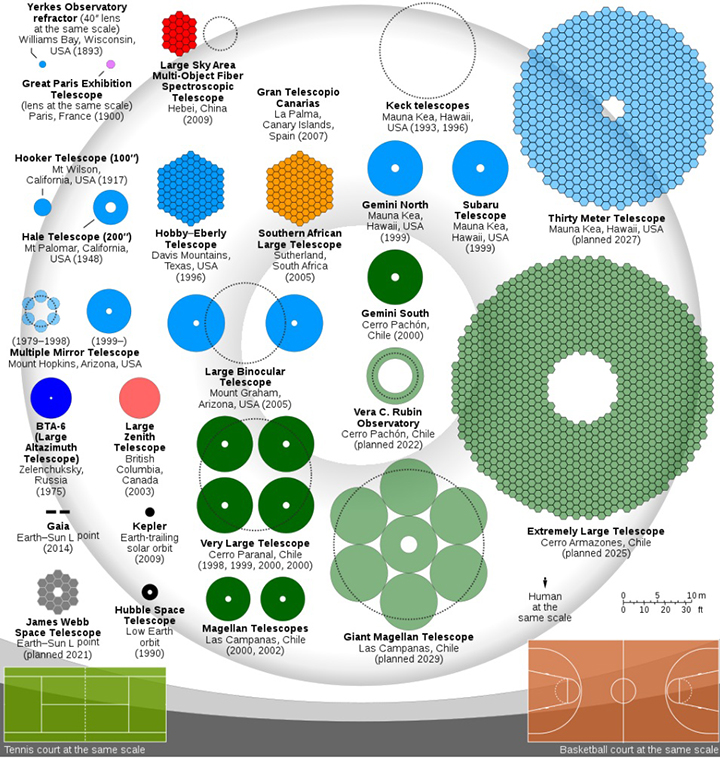
Credit: Wikipedia
Sixth mirror cast for Giant Magellan Telescope
The Giant Magellan Telescope announces fabrication of the sixth of seven of the world's largest monolithic mirrors. The process of casting the giant mirror at Arizona's Richard F. Caris Mirror Lab involves melting nearly 20 tons of high-purity, low-expansion, borosilicate glass (called E6 glass) into the world's only spinning furnace designed to cast giant mirrors for telescopes. At the peak of the melting process, the furnace spins at five revolutions per minute, heating the glass to 1,165 degrees Celsius for approximately five hours until it liquefies into the mold. The peak temperature event is called "high fire" and will occur on March 6, 2021. The mirror then enters a one month annealing process where the glass is cooled while the furnace spins at a slower rate in order to remove internal stresses and toughen the glass. It takes another 1.5 months to cool to room temperature. This "spin cast" process gives the mirror surface its special parabolic shape. Once cooled, the mirror will be polished for two years before reaching an optical surface precision of less than one thousandth of the width of a human hair.
Während das optische Konzept beim ELT und beim TMT dem der Keck Teleskope mit Primärspiegeln aus einer größeren Zahl von hexagonalen Segmenten ähnelt, besteht der Primärspiegel vom GMT aus nur sieben gewaltigen Einzelspiegeln von jeweils 8,4 m Durchmesser. Diese Spiegel werden nach dem von Roger Angel entwickelten Spin-Casting Verfahren hergestellt. Dabei rotiert die Glasschmelze und bildet so bereits die angestrebte Form eines Rotationsparaboloids, was den anschließenden Schleif und Poliervorgang wesentlich vereinfacht. Klingt einfach, ist bei großen Spiegeln mit einem Durchmesser von 8,4 m aber sehr aufwändig. Allein der langsame Abkühlvorgang dauert ein halbes Jahr!
The casting of the first mirror, in a rotating furnace, was completed on November 3, 2005, but the grinding and polishing were still going on 6½ years later when the second mirror was cast, on 14 January 2012. A third segment was cast in August 2013, and the fourth in September 2015. The casting of each mirror uses 20 tons of E6 borosilicate glass and takes about 12–13 weeks. After being cast, they need to cool for about six months.
Credit: Giant Magellan Telescope - GMTO Corporation
Credit: Steward Mirror Lab
Credit: Wikipedia

 ), Arecibo (RIP