
P_E_T_E_R
Aktives Mitglied
Oberflächlich betrachtet erscheint der Dewar Krater auf der Mondrückseite nicht besonders ungewöhnlich:
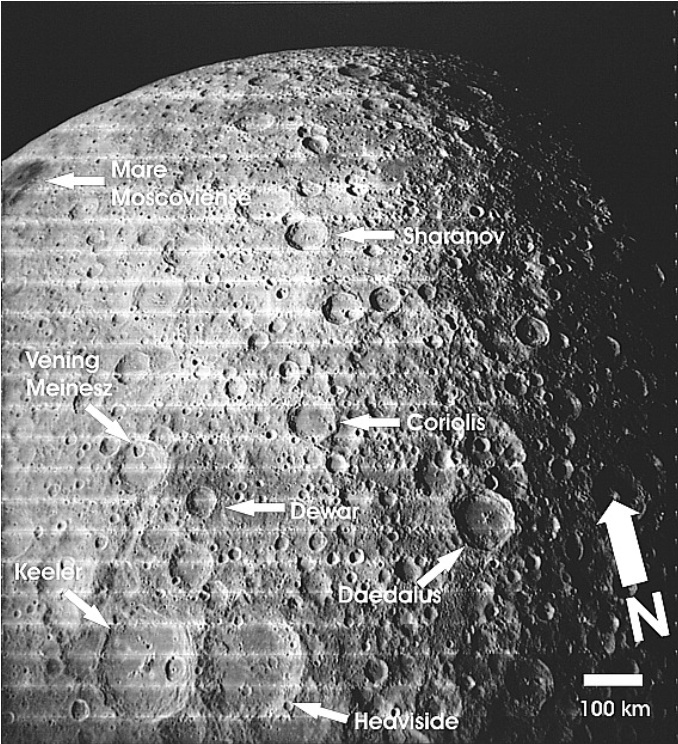
NASA Lunar Orbiter Photo II-034-M
Untersuchungen der Dichteverteilung mit den GRAIL-Sonden und Magnetfeldmessungen vom Lunar Prospector und der japanischen SELENE/Kaguya Mission geben allerdings Hinweise auf eine unter dem Krater verborgene Basaltblase aus erstarrtem Magma mit einer erhöhten Konzentration von Eisen-und Titanoxid, man spricht sogar von einem "Crypto Mare".
The far side of the moon provides clues to a past magnetic field
Siehe dazu auch:
Composition and origin of the Dewar geochemical anomaly
The distribution and extent of lunar swirls
Gruß, Peter
NASA Lunar Orbiter Photo II-034-M
Untersuchungen der Dichteverteilung mit den GRAIL-Sonden und Magnetfeldmessungen vom Lunar Prospector und der japanischen SELENE/Kaguya Mission geben allerdings Hinweise auf eine unter dem Krater verborgene Basaltblase aus erstarrtem Magma mit einer erhöhten Konzentration von Eisen-und Titanoxid, man spricht sogar von einem "Crypto Mare".
The far side of the moon provides clues to a past magnetic field
Unlike Earth, the moon no longer has a core-generated magnetic field. On our planet, the movement of liquid iron in the outer core generates a global magnetic field. This so-called geodynamo works on a similar principle to a bicycle dynamo, which converts mechanical motion into electrical energy. Today, there is an ongoing heated debate as to whether the moon also operated a dynamo in the past. This is because analyses of rock samples brought back to Earth by the Apollo astronauts are contradictory.
A study by ETH researchers, in collaboration with colleagues at the Institute of Space Research, DLR, and the Technical University of Berlin, now supports the dynamo theory. It concludes that 4.2 billion years ago - several hundred million years after its formation - the moon did indeed possess an internally generated magnetic field:
Magmatic origin of the Dewar magnetic anomaly: Implications for an early lunar dynamo
The result: In the Dewar region, beneath the lunar surface, lies a rock body approximately 60 kilometers wide, extending to a depth of around 9 kilometers. It is much denser than the surrounding crust while also strongly magnetized. Combined with the surface geochemistry and an arched topography, the researchers conclude that this is solidified magma that has risen from the subsurface - a buried volcanic complex. The age of the structure - 4.2 billion years - can be determined from the various deposits of impact material on the lunar surface.
Siehe dazu auch:
Composition and origin of the Dewar geochemical anomaly
The distribution and extent of lunar swirls
Gruß, Peter
Zuletzt bearbeitet: