NEO Update

Status
Es sind keine weiteren Antworten möglich.
Heute Abend kommt wieder was vorbei:

Asteroid 2018 CB Zips by Earth Friday: Watch it Online

2018 CB, an Apollo asteroid, was discovered on February 4th by the Catalina Sky Survey at magnitude 19. According to NASA's HORIZONS website, it will reach a peak magnitude of 12.8-13.0 for a few hours as it speeds from Perseus through Pisces. European and African observers are well-situated, with the asteroid plinking along under a dark, early evening sky.

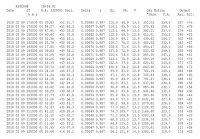
Im Anhang die Ephemeriden vom Minor Planet Center für Hamburg, was wohl mehr oder weniger auch für andere Orte hierzulande reichen sollte:
 

Anhänge

  • 2018_CB.jpg
    2018_CB.jpg
    97,2 KB · Aufrufe: 600
2010 WC9 ist ca. 100 Meter groß und passiert die Erde heute um Mitternacht in halbem Mondabstand: 2010 WC9

On 15 May 2018, 22:05 UT, the asteroid will approach the Earth at just over 0.5 LD. It is expected to reach apparent magnitude +11 at closest approach. At closest approach, it will be best seen from the Southern hemisphere such as South Africa and southern South America. The May 15 close approach is the closest of this asteroid in nearly 300 years.

In Deutschland kommt das Objekt heute Nacht jedoch nicht einmal über den Horizont ...
 
Am Samstag Abend gab es einen streifenden Treffer in Südafrika. Davon gibt es sogar Video-Aufnahmen:

NASA/JPL - Tiny Asteroid Discovered Saturday Disintegrates Hours Later Over Southern Africa

The event was witnessed by a number of observers and was caught on webcam video: Youtube

Meteor 2018 LA (ZLAF9B2) seen from farm between Ottosdal and Hartebeesfontein North West South Africa

Wikipedia

2018 LA also known as ZLAF9B2 was a small Apollo near-Earth asteroid approximately 2-3 meters in diameter that impacted Earth at roughly 16:44 UTC (18:44 local time) on 2 June 2018 near the border of Botswana and South Africa. It was discovered only 8 hours prior by the Mount Lemmon Survey, and based on an hour and a half of observations, it was calculated to have a roughly 85% chance of impacting Earth.

Hours later, a report arrived to the American Meteor Society that an observer from Botswana had seen a bright fireball. After the impact had occurred, observations from the Asteroid Terrestrial-impact Last Alert System (ATLAS) roughly 2 hours after the other reported observations were released, confirming that the asteroid had indeed impacted Earth on a grazing path.

The bolide was detected by infrasound at station I47 in South Africa and registered about 0.4 kT. The asteroid was several meters in diameter and impacted the atmosphere going about 17 km/s. Based on its velocity and energy, the asteroid was likely 2.0-2.8 meters in diameter.


Hier ein deutscher Artikel: Asteroid explodiert über Botswana.

Am Morgen des 2. Juni schlug eines dieser Systeme Alarm: In Aufnahmen des Catalina Sky Survey-Teleskops war die Signatur eines neuen und möglicherweise gefährlichen Asteroiden entdeckt worden. Sofort wurde die Entdeckung an das nächste Glied er Überwachungskette gemeldet: das Minor Planet Center in Massachusetts. Dort ermittelten Astronomen die vorläufige Flugbahn: Das Objekt befand sich auf Kollisionskurs mit der Erde.

"Die Entdeckung des Asteroiden 2018 LA ist erst das dritte Mal, dass ein Asteroid auf Kollisionskurs mit der Erde entdeckt worden ist", berichtet Paul Chodas vom Zentrum für erdnahe Objekte am Jet Propulsion Laboratory der NASA. "Es ist sogar erst das zweite Mal, dass eine hohe Einschlagswahrscheinlichkeit noch vor dem Impakt bekannt war."


Artikel im SPIEGEL: Asteroid explodiert in Erdatmosphäre

Beobachtungsvideo

Thomas
 
Zuletzt von einem Moderator bearbeitet:
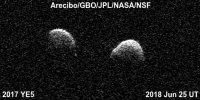
Das im Dezember entdeckte Objekt 2017 YE5 passierte die Erde am 21. Juni in sicherem Abstand von 16 LD und wurde dabei von drei großen Radarteleskopen erfasst. Dabei stellte sich heraus, dass der Asteroid aus zwei nahezu gleichgroßen Komponenten mit einem Durchmesser von jeweils 0,9 km besteht. Die Umlaufperiode beträgt ca. 22 h.

Observatories team up to reveal rare double asteroid

Youtube

Credit: NASA/JPL


Anhänge

  • 2017 YE5.jpg
    2017 YE5.jpg
    80 KB · Aufrufe: 445
Der Meteor, den keiner sah:

Sneaky Meteor Evades Earthling Detection, Explodes with Force of 10 Atomic Bombs

On Dec. 18, 2018, a school bus-size meteor exploded over Earth with an impact energy of roughly 10 atomic bombs. According to NASA, the blast was the second-largest meteor impact since the organization began tracking them 30 years ago, bested only by the infamous fireball that exploded over Chelyabinsk, Russia, in Feb. 2013.

Despite this, hardly anyone noticed it was happening - and nobody saw it coming.

As to why one of the largest meteor impacts in recent history may have totally passed you by, that's likely because the space rock in question shattered over the Bering Sea, a cold stretch of the Pacific Ocean between Russia and Alaska, miles from inhabited land.

NASA learned about the December impact thanks to the U.S. Air Force, whose missile-monitoring satellites were among the first to detect the blast. The rumble of the impact also registered on infrasound detectors - stations that measure low-frequency sound waves inaudible to human ears - around the world, giving scientists enough data to draw some basic conclusions about the sneaky meteor.

According to NASA, that meteor weighed about 1,360 metric tons, had a diameter of about 10 meters, and was traveling through the atmosphere at about 115,200 kilometers per hour when it exploded. The blast occurred about 25 km over the ocean and erupted with an energy equivalent to 173 kilotons of TNT - roughly 10 times the energy of the atomic bomb that the United States detonated over Hiroshima during World War II.


Fireballs.unlim.jpg


Fireballs.gt.100kt.jpg
 
Moin,

spannend, dass es Möglichkeiten gibt, die militärischen Daten auszuwerten ist ja fast schon befremdlich bei der amerikanischen Sicherheits-Paranoia.

CS
Jörg
 
A House-Size Asteroid Zipped by Earth Today

An asteroid the size of a house gave Earth a close shave today (April 18), passing nearer to our planet than any other space rock will for the rest of this year - that is, as far as we know.

Named 2019 GC6, the asteroid was discovered by NASA's Catalina Sky Survey near Tucson, Arizona, just last Tuesday (April 9), nine days before it flew by Earth. The giant rock made its closest approach this morning at 2:41 a.m. EDT (0641 GMT), when it whizzed by our plant at a safe distance of about 219,000 kilometers, or slightly more than half the average distance between Earth and the moon.

At the time, the asteroid was traveling at a relative speed of about 20,300 km/h, according to NASA's Jet Propulsion Laboratory. NASA estimated that the speeding space rock's diameter is "within a factor of two" of 15 meters, which means it may be up to 30 meters wide.


2019 GC6
 
Der Asteroid 1999 KW4 kommt der Erde gegenwärtig zwar nur bis auf eine minimale Distanz von 5,4 LD (Lunare Distanzen) nahe, so z.B. am 25. Mai auf 5,2 Millionen Kilometer, aber das könnte sich langfristig ändern. Der Asteroid hat einen Durchmesser von 1,3 km und einen kleineren Trabanten mit einem Durchmesser von ca. 360 m. Das Paar wurde bereits im Mai 2001 erstmals vom großen Arecibo-Dish und vom Goldstone Radar erfasst.

Bei der jetzigen Annäherung am 25. Mai wurde das Objekt mit der adaptiven Optik SPHERE am VLT der ESO auch bei optischen Wellenlängen aufgenommen, wobei die hohe Relativgeschwindigkeit des Objekts von 70.000 km/h eine besondere Herausforderung darstellte.

VLT observes a passing double asteroid hurtling by Earth at 70 000 km/h

108005


Goldstone radar images show a trail of a smaller component orbiting a larger object. This system was the third binary near-Earth asteroid pair revealed by radar, but it was the first time when scientists captured the complete orbit of one component around the other. The image was taken when the asteroid came within five million kilometers of Earth by the end of May 2001. Credit: NASA/Goldstone

108006


The left-hand image shows SPHERE observations of Asteroid 1999 KW4. An artist's impression of the asteroid pair is shown on the right. Credit: ESO
 
Radar Aufnahmen von 1999 KW4 mit dem 70 m großen Dish DSS-14 bei Goldstone mussten diesmal leider ausfallen, weil ein zum Betrieb erforderliches Hochleistungs-Klystron nicht rechtzeitig einsatzbereit war. Stattdessen sollte der kleinere DSS-13 Dish mit einem Durchmesser von 34 m mit Empfang über Green Bank in West Virginia zum Einsatz kommen. Ergebnisse stehen noch aus.
 
Ein Einschlag in der Karibik am 22. Juni konnte einem nur Stunden zuvor mit den ATLAS und Pan-STARRS Survey Teleskopen auf Hawaii erfassten Objekt zugeordnet werden:

UH team successfully locates incoming asteroid

2019 MO was a small, harmless 3-meter near-Earth asteroid that impacted into Earth on 22 June 2019 around 21:30 UT. It was detected by infrasound and generated a 5 kt bolide off the South coast of Puerto Rico. The strewn field would be spread over the Caribbean Sea.

NASA tracked small asteroid before it broke up in atmosphere

M.P.E.C. 2019-M72

110112


Credit: Larry Denneau (IfA/ATLAS), Brooks Bays (SOEST)


110113


Image shows the flash of an asteroid impacting Earth's atmosphere over the Caribbean Sea on June 22, 2019. It was captured by the Geostationary Lightning Mapper instrument aboard GOES-16, an Earth-monitoring satellite operated by NOAA and NASA. CIRA/CSU, RAMMB/NOAA/NASA. Credit: NASA
 
Am 24. Juli wurde am SONEAR Observatorium in Oliveira (Brasilien) der ca. 100 m große Asteroid 2019 OK aufgefunden, der nur einen Tag später am 25. Juli um 01:22 UTC, also gestern früh, im Abstand von nur 0,19 LD (73000 km) mit einer Relativgeschwindigkeit von 24,4 km/s die Erde passierte.

2019 OK

Die Ephemeriden (für Hamburg) zeigen, wie das Objekt zur Zeit seiner größten Annäherung mit einer wahnsinnigen Winkelgeschwindigkeit über den Himmel fegte, um dann innerhalb nur einer Stunde von mag 10 auf weniger als mag 16 abzufallen. Mittlerweile ist das Objekt mit einer theoretischen Magnitude von 40 schon längst nicht mehr sichtbar.

111706

Credit: JPL/Horizons
 
Der hundert Meter große NEO 2019 OK, der am 25. Juli in nur einem Fünftel der Monddistanz an der Erde vorbeikam, tauchte anscheinend schon Wochen vor seiner Passage auf Archivaufnahmen von Pan-STARRS und ATLAS auf, wurde aber wegen seiner geringen Eigenbewegung nicht erkannt.

The 100 m-wide asteroid dubbed '2019 OK' was detected just days before it passed Earth, although archival records from sky surveys show it had previously been observed but wasn't recognised as a near-Earth asteroid.

Asteroid's surprise close approach illustrates need for more eyes on the sky

The asteroid was first discovered by the Southern Observatory for Near-Earth Asteroids Research (SONEAR) just a day before its close approach.

ESA observed the asteroid just before its flyby, by requesting two separate telescopes in the International Scientific Optical Network (ISON) take images of the space rock.

Observations of 2019 OK were independently confirmed by other observatories, including the Arecibo radar in Puerto Rico and a third telescope in the ISON network.

Since the discovery, with knowledge of where the asteroid would have been and by searching for it by eye, existing images were found in the Pan-STARRS and ATLAS sky survey archives.

Both surveys had in fact captured the asteroid in the weeks before the flyby, but this slow space rock appeared to move just a tiny amount between images, and was therefore not recognised.

"This 'un-recognition' of an asteroid, despite it being photographed," explains Rüdiger Jehn, ESA's Head of Planetary Defence, "will be used to test the software going into ESA's upcoming asteroid-hunting telescope, the Flyeye."


2019 OK

Credit: ESA/ISON
 
Der hier kam sogar noch wesentlich näher ran: 2020 QG

2020 QG ... flew above the surface of Earth at a distance of approximately 2,940 kilometres (less than one-quarter of Earth's diameter) on 16 August 2020 at 04:09 UT. It was discovered on 16 August 2020 by the Zwicky Transient Facility at the Palomar Observatory about 6 hours after closest approach.

It is the closest known asteroid to fly by Earth that did not impact the planet. Given an absolute magnitude of 29.8, the asteroid is around 3 metres in diameter


A car-sized asteroid made the closest Earth flyby a space rock has ever survived
 
Ui! Das war aber knapp!! :oops:
Aus Richtung der Sonne ist aber auch fies...
3m...3000kg/m^3...12400m/s..... ähm, wären das 3,26TJ...?
Joa, das hätte man wohl früher als nach 6h bemerkt :whistle:
 
Hallo!

3m...3000kg/m^3...12400m/s... ähm, wären das 3,26TJ...

Laut Wikipedia sind 4,184 TJ = 1 Kilotonne TNT Äquivalent. Die Explosion in Beirut neulich hatte ein TNT Äquivalent von 1,1kT TNT. Also fast die selbe Sprengkraft. Allerdings wird die in den beiden Fällen ganz unterschiedlich umgesetzt. In Beirut wurde sie vollständig in Form von heissem Gas freigesetzt, welches mit seiner Druckwelle die großen Zerstörungen verursacht hat.
Beim Asteroideneinschlag kann man sich diese Form der Energiefreisetzung eher nicht vorstellen. Ausserdem wäre er in der Atmosphäre noch in kleinere Stücke zerbrochen, die dann vor dem Einschlag erheblich abgebremst worden wären. Wenn das ganze über dem Meer stattgefunden hätte - wofür die Wahrscheinlichkeit ja sehr groß ist - hätte man davon nicht viel bemerkt. Ausser denen, die es unmittelbar gesehen und gehört hätten.

Grüße
Maximilian
 
Moin,

das müsste doch von den automatischen Überwachungssystemen des Atomwaffensperrvertrags erkannt worden sein.

CS
Jörg
 
Hallo!

...das müsste doch von den automatischen Überwachungssystemen des Atomwaffensperrvertrags erkannt worden sein.

Vielleicht. Die Energiefreisetzung ist hier an der alleruntersten Grenze von dem, was Nuklearwaffen liefern. Und es fehlt auch die radioaktive Strahlung, die von vielen der verwendeten Detektoren (u.a. von denen auf den GPS Satelliten) gemessen werden.
Der Meteor von Tcheljabinsk hatte übrigens eine kinetische Energie von 500 kT TNT Äquivalent - 500x mehr als dieses Steinchen gestern. Und ausser ein paar zerbrochenen Fensterscheiben waren nicht viele Schäden zu beklagen. Wäre natürlich interessant zu wissen, wie die Atombombendetektoren darauf angesprochen haben.

Grüße
Maximilian
 
Wie zu erwarten hat die extrem dichte Passage von 2020 QG dessen Bahn erheblich verändert. JPL spricht von einem Ablenkungswinkel von 45°:

2020 QG - the Closest Flyby on Record

"It's really cool to see a small asteroid come by this close, because we can see the Earth's gravity dramatically bend its trajectory," said Paul Chodas, director of the Center for Near-Earth Object Studies (CNEOS) at NASA's Jet Propulsion Laboratory in Southern California. "Our calculations show that this asteroid got turned by 45 degrees or so as it swung by our planet."

Asteroid 2020 QG enters the record books as the closest known nonimpacting asteroid; many very small asteroids impact our planet every year, but only a few have actually been detected in space a few hours before impacting Earth. On average, an asteroid the size of 2020 QG passes this closely only a few times a year.
 
Am 2. November, also pünklich zur Wahl in den Staaten, kommt wieder was mit einem gewissen Einschlagpotential vorbei:

2018 VP1

Wurde seit der Entdeckung am 3. November 2018 nicht mehr gesichtet und die Begegnung in diesem Jahr passiert nominell in einem Abstand von 0,0028 AU ~ 420.000 km, also etwa Monddistanz, was aber wegen der Unsicherheit im Orbit einen möglichen Treffer mit einer Wahrscheinlichkeit von 1/240 nicht ganz ausschließt.

Mit einer geschätzten Größe von nur 2 Meter ist das Objekt aber relativ ungefährlich.
 
Morgen kommt wieder mal ein Schulbus vorbei:

2020 SW

A small near-Earth asteroid (or NEA) will briefly visit Earth's neighborhood on Thursday, Sept. 24, zooming past at a distance of about 22,000 kilometers above our planet's surface.

Based on its brightness, scientists estimate that 2020 SW is roughly 5 to 10 meters wide - or about the size of a small school bus.
 
2001 FO32 mit einem geschätzten Durchmesser von 550 m passierte gestern nachmittag um 17 Uhr MEZ in einem Abstand von 1,25 Millionen km oder 5,25 LD.

Der Asteroid bewegt sich mit einer Umlaufzeit von 2,2 Jahren auf einer stark elongierten und stark geneigten Bahn mit einem Sonnenabstand zwischen 0,3 und 3,1 AU. Dabei kreuzt er die Bahnen aller inneren Planeten von Merkur bis Mars.

Asteroid 2001 FO32 Will Safely Pass by Earth March 21

2001 FO32.jpg

Credit: NASA/JPL

Eine Beobachtung dürfte sehr schwierig sein. Wenn er heute von Süden kommend mit einem Affenzahn die Ekliptik nach Norden durchschreitet, fällt seine Helligkeit sehr schnell innerhalb von einem Tag von 15 auf 21 mag ab.

2001 FO32 eph.jpg

Credit: NASA/JPL/HORIZONS
 
Zuletzt bearbeitet:
Status
Es sind keine weiteren Antworten möglich.
Zurück
Oben