
Du verwendest einen veralteten Browser. Dieser kann eventuell diese oder andere Webseiten nicht richtig darstellen.
Du solltest deinen Browser aktualisieren oder einen alternativen Browser verwenden.
Du solltest deinen Browser aktualisieren oder einen alternativen Browser verwenden.
Messenger: Die Merkur-Sonde nach Mariner 10
- Ersteller des Themas blue_scape
- Erstellungsdatum
- Status
- Es sind keine weiteren Antworten möglich.
P_E_T_E_R
Aktives Mitglied
Anhänge
P_E_T_E_R
Aktives Mitglied
Anhänge
P_E_T_E_R
Aktives Mitglied
Re: Neue Messenger Bilder
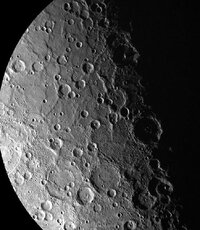
100 Orbits and Counting
The data gathered so far include more than 70 million magnetic field measurements, 300,000 visible and infrared spectra of the surface, 16,000 images, and 12,000 X-ray and 9,000 gamma-ray spectra probing the elemental composition of Mercury’s uppermost crust.
MESSENGER continues its science-mapping phase in orbit around Mercury. All spacecraft systems remain safe and healthy, and all science instruments are on and continue to collect data according to the baseline observation plan.
“Over the next several weeks, MESSENGER’s subsystems and instruments will experience their hottest temperatures yet as the spacecraft crosses between the planet’s surface and our Sun at high noon close to the planet, preceded by hour-long eclipses near local midnight with only the spacecraft battery to keep the spacecraft alive in the dark of Mercury’s night,” notes MESSENGER Project Scientist Ralph McNutt.
Latest Messenger Images
100 Orbits and Counting
The data gathered so far include more than 70 million magnetic field measurements, 300,000 visible and infrared spectra of the surface, 16,000 images, and 12,000 X-ray and 9,000 gamma-ray spectra probing the elemental composition of Mercury’s uppermost crust.
MESSENGER continues its science-mapping phase in orbit around Mercury. All spacecraft systems remain safe and healthy, and all science instruments are on and continue to collect data according to the baseline observation plan.
“Over the next several weeks, MESSENGER’s subsystems and instruments will experience their hottest temperatures yet as the spacecraft crosses between the planet’s surface and our Sun at high noon close to the planet, preceded by hour-long eclipses near local midnight with only the spacecraft battery to keep the spacecraft alive in the dark of Mercury’s night,” notes MESSENGER Project Scientist Ralph McNutt.
Latest Messenger Images
Anhänge
P_E_T_E_R
Aktives Mitglied
Anhänge
P_E_T_E_R
Aktives Mitglied
Anhänge
Ehemaliges Mitglied 8776
Re: Neue Messenger Bilder
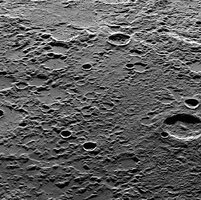
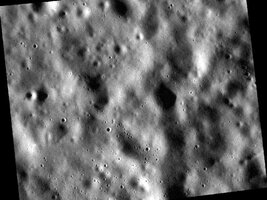
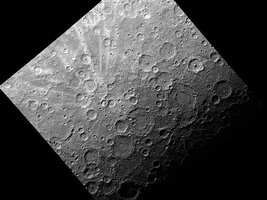
Wenn man böse wäre - aber wer ist das - könnte man meinen, eine Art "warmer Mond" ...
Aber immerhin, eine tolle Leistung mit der Sonde, mal sehen, was dabei noch alles rauskommt.
Jörg
Wenn man böse wäre - aber wer ist das - könnte man meinen, eine Art "warmer Mond" ...
Aber immerhin, eine tolle Leistung mit der Sonde, mal sehen, was dabei noch alles rauskommt.
Jörg

ThN
Aktives Mitglied
Doch nicht so uninteressant!
Bizarre Landschaftsformationen ("ausgestanzte Vertiefungen"), Dicke Lavaschichten in der Polargegend, stark asymmetrisches Magnetfeld, chemische Zusammensetzung der Oberfläche...
Siehe NASA Pressekonferenz bzw. SPIEGEL Online.
Thomas
Bizarre Landschaftsformationen ("ausgestanzte Vertiefungen"), Dicke Lavaschichten in der Polargegend, stark asymmetrisches Magnetfeld, chemische Zusammensetzung der Oberfläche...
Siehe NASA Pressekonferenz bzw. SPIEGEL Online.
Thomas
P_E_T_E_R
Aktives Mitglied
Re: Doch nicht so uninteressant!
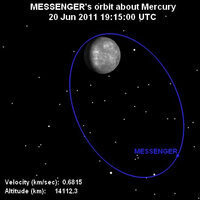
Übrigens, der Orbit von Messenger wurde am 15. Juni mit einem kurzen Bremsmaneuver weiter abgesenkt, so dass er sich der Oberfläche am tiefsten Punkt seiner Bahnellipse jetzt regelmäßig bis auf 200 km nähert.
Messenger adjusts its orbit around Mercury
Where is Messenger?
Übrigens, der Orbit von Messenger wurde am 15. Juni mit einem kurzen Bremsmaneuver weiter abgesenkt, so dass er sich der Oberfläche am tiefsten Punkt seiner Bahnellipse jetzt regelmäßig bis auf 200 km nähert.
Messenger adjusts its orbit around Mercury
Where is Messenger?
Anhänge
P_E_T_E_R
Aktives Mitglied
Anhänge
P_E_T_E_R
Aktives Mitglied
Anhänge
P_E_T_E_R
Aktives Mitglied
Anhänge
P_E_T_E_R
Aktives Mitglied
Anhänge
P_E_T_E_R
Aktives Mitglied
Anhänge
P_E_T_E_R
Aktives Mitglied
Anhänge
P_E_T_E_R
Aktives Mitglied
Re: more images
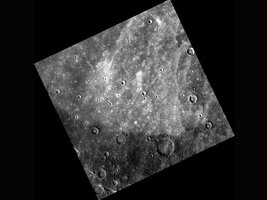
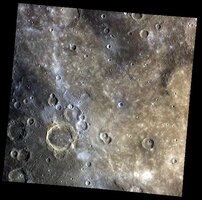
Firdousi's Smooth Plains & Crater Chains
Firdousi's Smooth Plains & Crater Chains
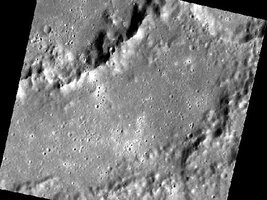
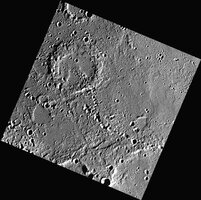
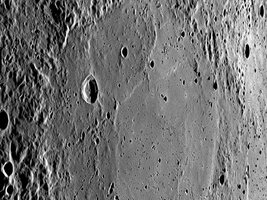
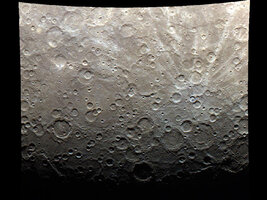
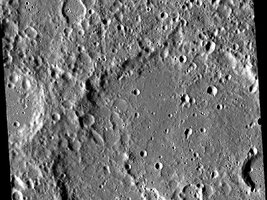
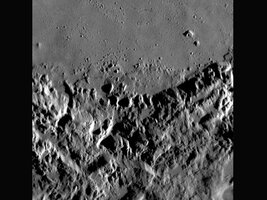
This image shows a portion of Mercury's surface mainly consisting of smooth plains material. This lighter, smoother area of plains is younger than the darker, rougher surrounding terrain near the edges of this image. Firdousi crater and its halo of small secondary craters is also apparent in this image, in the lower left quadrant.
Firdousi's Smooth Plains & Crater Chains
Firdousi's Smooth Plains & Crater Chains
This image shows a portion of Mercury's surface mainly consisting of smooth plains material. This lighter, smoother area of plains is younger than the darker, rougher surrounding terrain near the edges of this image. Firdousi crater and its halo of small secondary craters is also apparent in this image, in the lower left quadrant.
Anhänge
P_E_T_E_R
Aktives Mitglied
Anhänge
P_E_T_E_R
Aktives Mitglied
Anhänge
P_E_T_E_R
Aktives Mitglied
Anhänge
P_E_T_E_R
Aktives Mitglied
Messenger Update
Messenger Update
Mapping Status
Bei der Kartographierung der Oberfläche gibt es immer noch einige weiße Flecken. Wegen der langsamen Rotationsperiode (Spin und Orbit befinden sich in einer 3/2 Resonanz, ein Sonnentag dauert auf Merkur zwei Orbitperioden, also 2 x 88 = 176 Erdtage) dauert es entsprechend lange, bis auch diese abgedeckt sind.
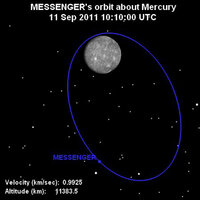
Ein Umlauf der Sonde um Merkur ist aus Kommunikationsgründen mit dem Deep Space Network auf nominell 12 Stunden fixiert. Beim Absenken der Bahnellipse im Juni auf eine minimale Annäherung von 200 km hatte sich die Umlaufperiode geringfügig auf 11h 48min verkürzt. Weitere Korrekturmaneuver am 27. Juli und am 7. September sollten die Umlaufperiode und dem minimalen Abstand wieder auf 12h und 200 km justieren: Orbit Adjustments
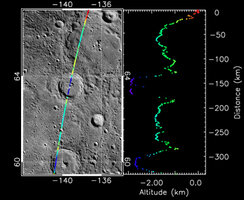
Höhenprofilmessungen mit MLA und MDIS
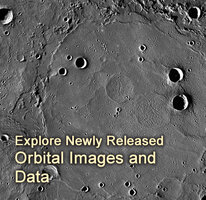
MESSENGER Orbital Data in Planetary Data System
Messenger Update
Mapping Status
Bei der Kartographierung der Oberfläche gibt es immer noch einige weiße Flecken. Wegen der langsamen Rotationsperiode (Spin und Orbit befinden sich in einer 3/2 Resonanz, ein Sonnentag dauert auf Merkur zwei Orbitperioden, also 2 x 88 = 176 Erdtage) dauert es entsprechend lange, bis auch diese abgedeckt sind.
Ein Umlauf der Sonde um Merkur ist aus Kommunikationsgründen mit dem Deep Space Network auf nominell 12 Stunden fixiert. Beim Absenken der Bahnellipse im Juni auf eine minimale Annäherung von 200 km hatte sich die Umlaufperiode geringfügig auf 11h 48min verkürzt. Weitere Korrekturmaneuver am 27. Juli und am 7. September sollten die Umlaufperiode und dem minimalen Abstand wieder auf 12h und 200 km justieren: Orbit Adjustments
Höhenprofilmessungen mit MLA und MDIS
MESSENGER Orbital Data in Planetary Data System
Anhänge
P_E_T_E_R
Aktives Mitglied
Anhänge
P_E_T_E_R
Aktives Mitglied
Anhänge
P_E_T_E_R
Aktives Mitglied
Re: Messenger Update
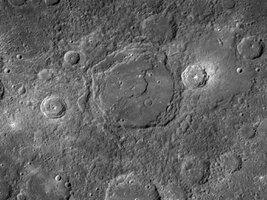
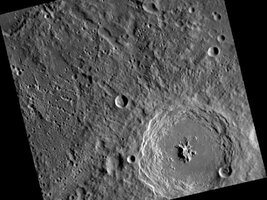
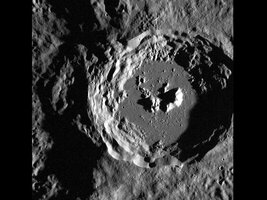
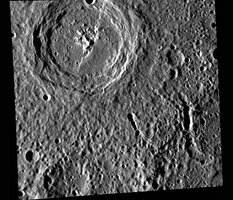
An Appointment with Mr. Yeates
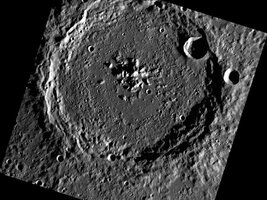
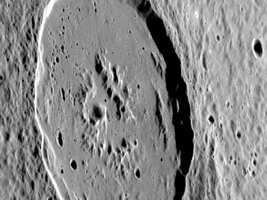
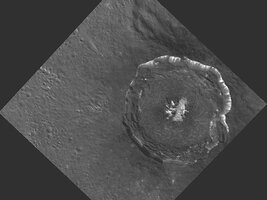
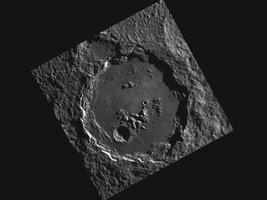
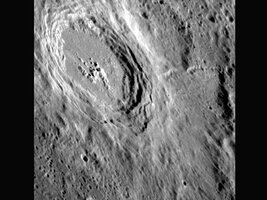
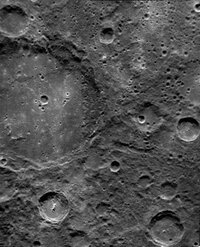
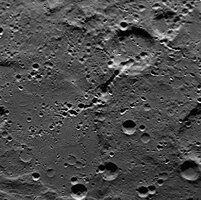
This image is dominated by the 92-km diameter crater Yeats, named for William Butler Yeats. Yeats the man was an Irish poet and dramatist (winner of the Nobel Prize for Literature in 1923) who lived from 1865 to 1939. Yeats the crater exhibits radially textured ejecta, wall terraces, and bright central peaks. A lobate scarp crosses the floor from the 1 o'clock to 7 o'clock position.
An Appointment with Mr. Yeates
This image is dominated by the 92-km diameter crater Yeats, named for William Butler Yeats. Yeats the man was an Irish poet and dramatist (winner of the Nobel Prize for Literature in 1923) who lived from 1865 to 1939. Yeats the crater exhibits radially textured ejecta, wall terraces, and bright central peaks. A lobate scarp crosses the floor from the 1 o'clock to 7 o'clock position.
Anhänge

maximilian
Aktives Mitglied
Re: Messenger Update
Hallo!
Sorry, hier muss ich meinem Unmut Ausdruck verleihen! (Leider werden es die Verantwortlichen nicht lesen...)
W.B.Yeats hat wahrhaftig besseres verdient als diesen unbedeutenden Merkurkrater! Dann lieber gar nichts als sowas.
Grüße,
Maximilian
Hallo!
Sorry, hier muss ich meinem Unmut Ausdruck verleihen! (Leider werden es die Verantwortlichen nicht lesen...)
W.B.Yeats hat wahrhaftig besseres verdient als diesen unbedeutenden Merkurkrater! Dann lieber gar nichts als sowas.
Grüße,
Maximilian
- Status
- Es sind keine weiteren Antworten möglich.