

Ernst_Pollmann
Aktives Mitglied
Der bekannte Be-Sternforscher Anatoly Miroshnichenko bat mich via eMail aktuell um Weiterleitung seiner nachfolgenden Mitteilung:
---------------------------------------------------------------
Hello everybody,
Yesterday I received information from a group of interferometrists
that an eccentric binary Alpha Oph (visual magnitude about 2.0) is
going to have a periastron passage very soon. The primary component is
a rapidly rotating A5 star with a mass of about 2.3 solar mass and the
secondary component has a mass of about 0.85 solar mass. The
eccentricity is 0.92. The periastron time is expected for April 19,
2012, but it has a huge uncertainty of 53 days. This is similar to the
situation for Delta Sco in 2000.
Although they contacted me pretty late and there is a chance that the
periastron has already passed, it would be great if the amateur
community take part in the monitoring of this binary at least in April
through June. This will allow to refine the periastron time.
As the system does not have spectral lines in emission, the H-alpha
region seems to be a good candidate for the monitoring. However as the
primary rotates rapidly, the lines are broad. Therefore, echelle
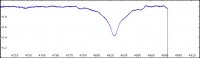
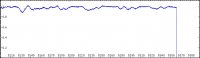
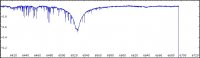
spectra would work better, as they contain more lines. I found a
spectrum of Alpha Oph in the Elodie archive and normalized a few parts
to the continuum for you to see what to expect (three parts attached).
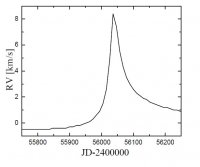
However, there is a challenge in detecting the radial velocity
variations as the total amplitude of the primary's radial velocity is
going to be only about 10 km/s (if I calculated it correctly). I used
orbital elements from a recent paper by Hinkley et al. 2011;
http://adsabs.harvard.edu/abs/2011ApJ...726..104H. My prediction for
the radial velocity curve is attached (AlpOph_RV.pdf). It assumes a
zero systemic velocity.
Could you please spread the word to other possible participants to
this campaign (if you think it is feasible)?
I think a spectrum with a high signal-to-noise ratio every clear night
starting now would do the job. Please consider getting a radial
velocity standard with each observations of the object. A bright star
Beta Oph (V=2.8 mag, K2 III, RV = -12.3 km/s) or a fainter star BS
6349 (V=6.0 mag, F9 V, RV=-16.7 km/s) are good standards.
Is it possible to set up a webpage for this campaign to deposit reduced spectra?
Thank you.
Best regards,
Anatoly
--
Dr. Anatoly Miroshnichenko
Assoc. Professor
University of North Carolina at Greensboro
Dept. of Physics and Astronomy
Phone: 336-334-5062
web: http://www.uncg.edu/~a_mirosh
-----------------------------------------------
Ernst Pollmann
------------------------------------------
Active Spectroscopy in Astronomy
http://www.astrospectroscopy.de
http://www.astronomie.de/astronomische-fachgebiete/spektroskopie/
---------------------------------------------------------------
Hello everybody,
Yesterday I received information from a group of interferometrists
that an eccentric binary Alpha Oph (visual magnitude about 2.0) is
going to have a periastron passage very soon. The primary component is
a rapidly rotating A5 star with a mass of about 2.3 solar mass and the
secondary component has a mass of about 0.85 solar mass. The
eccentricity is 0.92. The periastron time is expected for April 19,
2012, but it has a huge uncertainty of 53 days. This is similar to the
situation for Delta Sco in 2000.
Although they contacted me pretty late and there is a chance that the
periastron has already passed, it would be great if the amateur
community take part in the monitoring of this binary at least in April
through June. This will allow to refine the periastron time.
As the system does not have spectral lines in emission, the H-alpha
region seems to be a good candidate for the monitoring. However as the
primary rotates rapidly, the lines are broad. Therefore, echelle
spectra would work better, as they contain more lines. I found a
spectrum of Alpha Oph in the Elodie archive and normalized a few parts
to the continuum for you to see what to expect (three parts attached).
However, there is a challenge in detecting the radial velocity
variations as the total amplitude of the primary's radial velocity is
going to be only about 10 km/s (if I calculated it correctly). I used
orbital elements from a recent paper by Hinkley et al. 2011;
http://adsabs.harvard.edu/abs/2011ApJ...726..104H. My prediction for
the radial velocity curve is attached (AlpOph_RV.pdf). It assumes a
zero systemic velocity.
Could you please spread the word to other possible participants to
this campaign (if you think it is feasible)?
I think a spectrum with a high signal-to-noise ratio every clear night
starting now would do the job. Please consider getting a radial
velocity standard with each observations of the object. A bright star
Beta Oph (V=2.8 mag, K2 III, RV = -12.3 km/s) or a fainter star BS
6349 (V=6.0 mag, F9 V, RV=-16.7 km/s) are good standards.
Is it possible to set up a webpage for this campaign to deposit reduced spectra?
Thank you.
Best regards,
Anatoly
--
Dr. Anatoly Miroshnichenko
Assoc. Professor
University of North Carolina at Greensboro
Dept. of Physics and Astronomy
Phone: 336-334-5062
web: http://www.uncg.edu/~a_mirosh
-----------------------------------------------
Ernst Pollmann
------------------------------------------
Active Spectroscopy in Astronomy
http://www.astrospectroscopy.de
http://www.astronomie.de/astronomische-fachgebiete/spektroskopie/
Anhänge
Zuletzt von einem Moderator bearbeitet: