
Du verwendest einen veralteten Browser. Dieser kann eventuell diese oder andere Webseiten nicht richtig darstellen.
Du solltest deinen Browser aktualisieren oder einen alternativen Browser verwenden.
Du solltest deinen Browser aktualisieren oder einen alternativen Browser verwenden.
Mars Science Laboratory
- Ersteller des Themas clapebe
- Erstellungsdatum
- Status
- Es sind keine weiteren Antworten möglich.

portaball
Aktives Mitglied
Nun wurde ein schöner Metallmeteorit gefunden und fotografiert:
Link zur Grafik: https://i.kinja-img.com/gawker-media/image/upload/s--BTtavFpo--/c_scale,fl_progressive,q_80,w_800/ydkindt4mmmbyuupffr6.jpg
http://gizmodo.com/curiosity-just-found-a-freaky-metal-meteorite-on-mars-1788441834
Ich frage mich nur, weshalb liegt der so schön rund und unverformt auf der platten Oberfläche und nicht zerdeppert in einem Einschlagkrater?
Grüße Jochen
Link zur Grafik: https://i.kinja-img.com/gawker-media/image/upload/s--BTtavFpo--/c_scale,fl_progressive,q_80,w_800/ydkindt4mmmbyuupffr6.jpg
http://gizmodo.com/curiosity-just-found-a-freaky-metal-meteorite-on-mars-1788441834
Ich frage mich nur, weshalb liegt der so schön rund und unverformt auf der platten Oberfläche und nicht zerdeppert in einem Einschlagkrater?
Grüße Jochen
P_E_T_E_R
Aktives Mitglied
Um Curiosity ist es ja in letzter Zeit ziemlich still geworden, obwohl es weiterhin funktioniert und forscht.
Jetzt gibt es aber Neuigkeiten, die aufhorchen lassen. Die Sonde hat nämlich gerade Methan-Konzentrationen gefunden, die dreimal höher als jemals zuvor gefundene sind:
Curiosity Rover finds high levels of methane on Mars
The methane readings were reportedly three times as high as the previous record on Mars - enough for officials at NASA to change the schedule for the rover over the weekend. They had the rolling probe take more readings at the same site, which, the JPL reports, should be ready for release as early as today. If the readings are due to some form of life, NASA scientists expect it would be in the form of microbes living just under the surface.
This week, NASA's Curiosity Mars rover found a surprising result: the largest amount of methane ever measured during the mission - about 21 parts per billion units by volume (ppbv). One ppbv means that if you take a volume of air on Mars, one billionth of the volume of air is methane.
Jetzt gibt es aber Neuigkeiten, die aufhorchen lassen. Die Sonde hat nämlich gerade Methan-Konzentrationen gefunden, die dreimal höher als jemals zuvor gefundene sind:
Curiosity Rover finds high levels of methane on Mars
The methane readings were reportedly three times as high as the previous record on Mars - enough for officials at NASA to change the schedule for the rover over the weekend. They had the rolling probe take more readings at the same site, which, the JPL reports, should be ready for release as early as today. If the readings are due to some form of life, NASA scientists expect it would be in the form of microbes living just under the surface.
This week, NASA's Curiosity Mars rover found a surprising result: the largest amount of methane ever measured during the mission - about 21 parts per billion units by volume (ppbv). One ppbv means that if you take a volume of air on Mars, one billionth of the volume of air is methane.

ThN
Aktives Mitglied
Na, das wird ja interessant. Der Trace Gas Orbiter der ESA hat bisher kein Methan in der Atmosphäre gefunden. Dazu habe ich hier: ESA & Roskosmos - gemeinsam zum Mars folgendes Zitat gebracht:
“What is needed now is a carefully planned and coordinated set of observations between the Trace Gas Orbiter and Curiosity.”
Bin schon gespannt. Es gibt ja sogar Ideen, dass das Methan in Boden-Nähe wieder auf irgend eine Art abgebaut wird, bevor es in die Atmospäre entweicht.
Thomas
“What is needed now is a carefully planned and coordinated set of observations between the Trace Gas Orbiter and Curiosity.”
Bin schon gespannt. Es gibt ja sogar Ideen, dass das Methan in Boden-Nähe wieder auf irgend eine Art abgebaut wird, bevor es in die Atmospäre entweicht.
Thomas
P_E_T_E_R
Aktives Mitglied
Es gibt ja sogar Ideen, dass das Methan in Boden-Nähe wieder auf irgend eine Art abgebaut wird, bevor es in die Atmospäre entweicht.
Curiosity Detects Big Whiff of Methane on Mars
Now you see it, now you don’t: The Curiosity rover on Mars detected the highest level of methane yet, but a follow-on experiment saw those levels recede within a week. Scientists are working to understand the significance of the result.
When SAM sniffed the air again, just days after the record-breaking whiff, the methane was gone. Levels had returned to background levels of about 1 ppbv. (If you take a unit of volume, one billionth of it would be methane.)
There’s been an ongoing controversy over methane in Martian air. Curiosity has detected spikes of methane during its time on the surface, although at other times it has reported methane levels near zero. Some of Curiosity’s methane spikes have been confirmed by orbital measurements from Mars Express. But the European Space Agency’s ExoMars Trace Gas Orbiter (TGO) has found no evidence of the gas, even during one of Curiosity’s spike.
P_E_T_E_R
Aktives Mitglied
HiRISE spots Curiosity rover at Mars' Woodland Bay
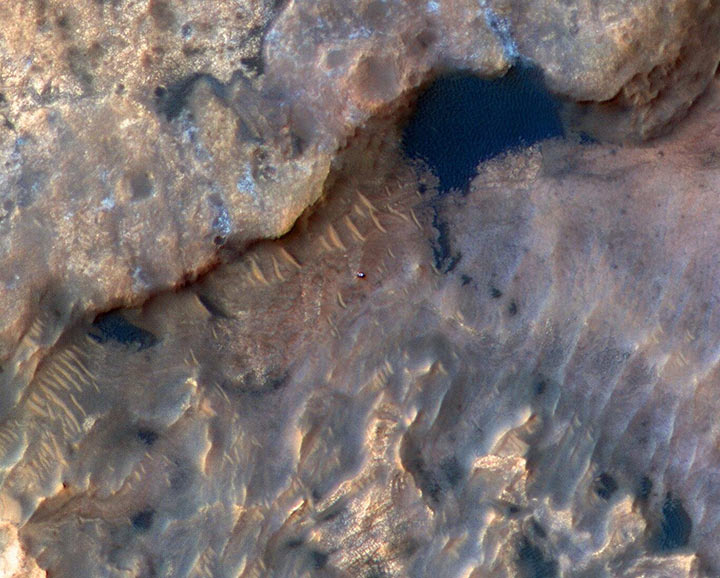
NASA's Curiosity Mars rover can be seen in this image taken from space on May 31, 2019, by the HiRISE camera aboard the Mars Reconnaissance Orbiter. In the image, Curiosity appears as a bluish speck. Credit: NASA/JPL-Caltech
NASA's Curiosity Mars rover can be seen in this image taken from space on May 31, 2019, by the HiRISE camera aboard the Mars Reconnaissance Orbiter. In the image, Curiosity appears as a bluish speck. Credit: NASA/JPL-Caltech
P_E_T_E_R
Aktives Mitglied
Ein Update vom Mars Rover Curiosity: Über Thanksgiving hatte der Rover mit seiner Mastkamera ein detailliertes Panorama aus mehr als 1000 hochaufgelösten Einzelaufnahmen zusammengestellt, das jetzt veröffentlicht wurde:
Curiosity Mars rover snaps its highest-resolution panorama yet
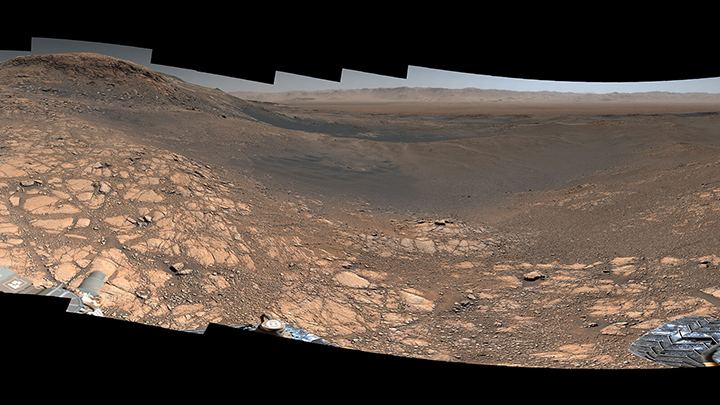
Credit: NASA/JPL-Caltech/MSSS
Narrated Video (YouTube)
Curiosity Mars rover snaps its highest-resolution panorama yet
Credit: NASA/JPL-Caltech/MSSS
Narrated Video (YouTube)
P_E_T_E_R
Aktives Mitglied
Wie kommt Thiophen C4H4S auf den Mars? Das benzol-ähnliche Molekül

kann sowohl über biologische als auch rein chemische Prozesse entstehen. Der Nachweis dieser Verbindung in uralten Marssedimenten ist zwar hochinteressant, für sich genommen aber nicht ausreichend für eine biologische Herkunft.
Thiophene derivatives have been detected at nanomole levels in 3.5 billions year old Martian soil sediments (Murray Formation, Pahrump Hills) by the rover Curiosity at Gale crater (Mars) between 2012 and 2017. It represents an important milestone for the mission of the Mars Science Laboratory (MSL) in the long and elusive quest of organic matter on the red planet. Heating at high temperature (500° to 820 °C) of lacustrine mudstone samples by the Sample Analysis at Mars (SAM) instrument allowed gas chromatography-mass-spectrometry (GC-MS) analyses of the evolved gases and the detection of aromatic and aliphatic molecules including several thiophene compounds.
The origin and the mode of formation of these molecules are still unknown, but their discovery put forward the puzzling question of thiophenic compounds as possible ancient biosignature on Mars.
Zwei Astrobiologen von der TU Berlin, Jacob Heinz und Dirk Schulze-Makuch gehen dieser Frage in einem neuen Artikel in der Zeitschrift Astrobiology nach:
Thiophenes on Mars: Biotic or Abiotic Origin?
Organic molecules discovered by Curiosity Rover consistent with early life on Mars: study
Übrigens wusste ich gar nicht, dass Weiße Trüffel das Zeugs enthalten:
Organic compounds called thiophenes are found on Earth in coal, crude oil and oddly enough, in white truffles, the mushroom beloved by epicureans and wild pigs.
kann sowohl über biologische als auch rein chemische Prozesse entstehen. Der Nachweis dieser Verbindung in uralten Marssedimenten ist zwar hochinteressant, für sich genommen aber nicht ausreichend für eine biologische Herkunft.
Thiophene derivatives have been detected at nanomole levels in 3.5 billions year old Martian soil sediments (Murray Formation, Pahrump Hills) by the rover Curiosity at Gale crater (Mars) between 2012 and 2017. It represents an important milestone for the mission of the Mars Science Laboratory (MSL) in the long and elusive quest of organic matter on the red planet. Heating at high temperature (500° to 820 °C) of lacustrine mudstone samples by the Sample Analysis at Mars (SAM) instrument allowed gas chromatography-mass-spectrometry (GC-MS) analyses of the evolved gases and the detection of aromatic and aliphatic molecules including several thiophene compounds.
The origin and the mode of formation of these molecules are still unknown, but their discovery put forward the puzzling question of thiophenic compounds as possible ancient biosignature on Mars.
Zwei Astrobiologen von der TU Berlin, Jacob Heinz und Dirk Schulze-Makuch gehen dieser Frage in einem neuen Artikel in der Zeitschrift Astrobiology nach:
Thiophenes on Mars: Biotic or Abiotic Origin?
Organic molecules discovered by Curiosity Rover consistent with early life on Mars: study
Übrigens wusste ich gar nicht, dass Weiße Trüffel das Zeugs enthalten:
Organic compounds called thiophenes are found on Earth in coal, crude oil and oddly enough, in white truffles, the mushroom beloved by epicureans and wild pigs.
Ehemaliges Mitglied 31195
Das erste irdische Säugetier im All war ein Hund. Warum nicht ein Trüffelschwein auf dem Mars?
*entfernt*
*entfernt*
P_E_T_E_R
Aktives Mitglied
... da war doch noch dieser andere Rover, ich meine den ohne Helicopter, der meint er sei auch noch da!
Curiosity Mars Rover Takes Selfie With ‘Mont Mercou’
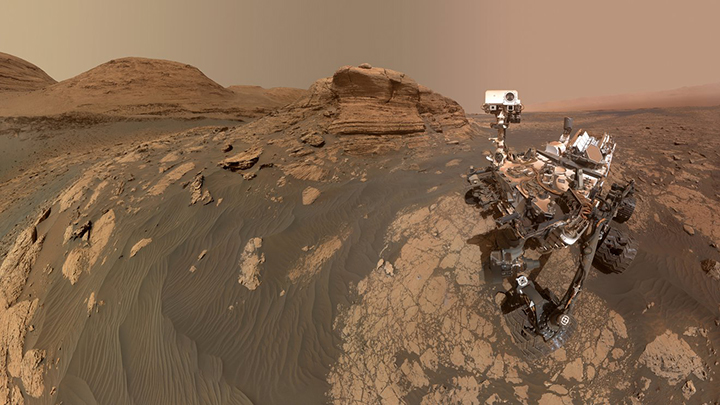
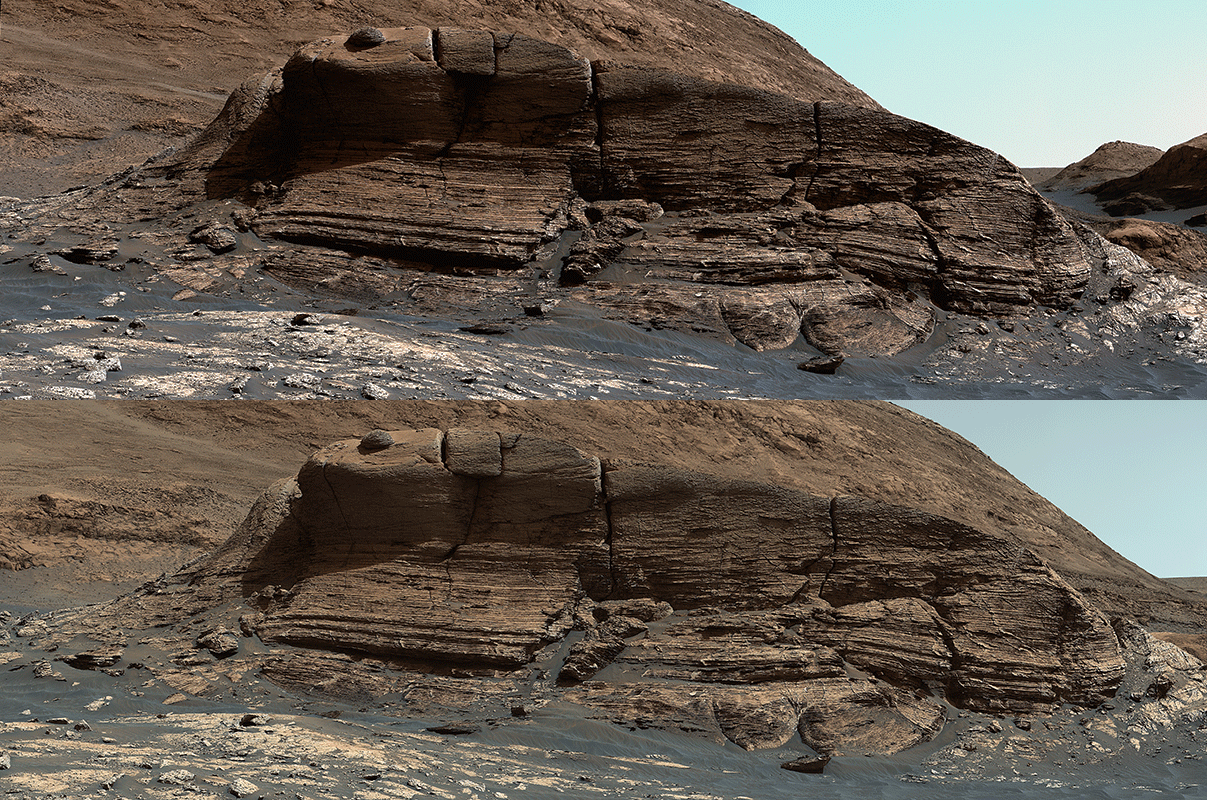
Credit: NASA/JPL-Caltech/MSSS
Curiosity Mars Rover Takes Selfie With ‘Mont Mercou’
Credit: NASA/JPL-Caltech/MSSS
P_E_T_E_R
Aktives Mitglied
Zuletzt bearbeitet:

MiMeDo
Aktives Mitglied
Zuckelt nach wie vor fleissig auf seinem Hügel da rum.
Man kann das ganze verfolgen z.B. da:
 www.unmannedspaceflight.com
Gruss
Thorsten
Man kann das ganze verfolgen z.B. da:
Unmanned Spaceflight.com -> MSL
Gruss
Thorsten

P_E_T_E_R
Aktives Mitglied
Das sieht aus wie zwei Fulgurite. Kann das sein, auf dem Mars?
Hallo Sebastian, keine Ahnung, ob es auf dem Mars mal Gewitter und Blitzeinschläge wie auf der Erde gab?!
Diese seltsamen Strukturen sehen ja äußerst fragil aus und waren vermutlich für lange Zeit eingebettet in Sedimente oder weicheres Gestein, was dann aber durch Erosion verschwunden ist. So ähnlich wird es auch hier gedeutet:
These bizarre spiky Mars rocks likely formed by erosion and ancient fractures
Diese Säulen erinnern mich irgendwie auch an ähnliche Strukturen, wie man sie am Mono Lake in Kalifornien vorfindet. Diese Tufa Towers bestehen aber aus Kalk und haben eine ganz andere Entstehungsgeschichte.
Gruß, Peter
Eigenes Foto (2004)
Zuletzt bearbeitet:
ThN
Aktives Mitglied
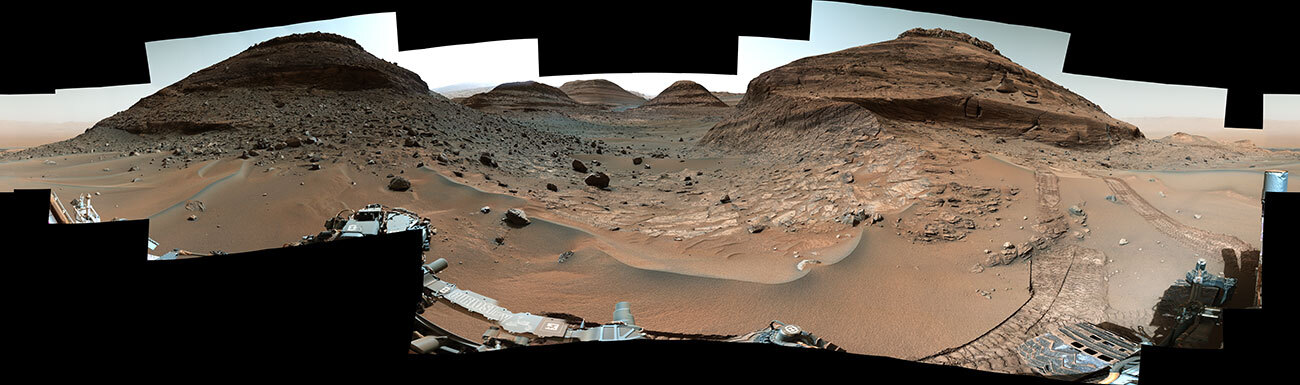
Curiosity Mars Rover Reaches Long-Awaited Salty Region – NASA Mars Exploration
After years of climbing, the Mars rover has arrived at a special region believed to have formed as Mars’ climate was drying.
 mars.nasa.gov
Thomas
- Status
- Es sind keine weiteren Antworten möglich.