Mars Science Laboratory

Status
Es sind keine weiteren Antworten möglich.
Re: First Scoop

ist eure Neugier bzgl. Curiosity schon abgeflacht?
dabei gibt es doch täglich neues, sogar in Tageszeitungen...
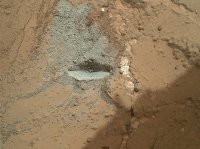
Der jüngste Fund des Mars-Roboters "Curiosity" stellt die Forscher vor ein Rätsel. Der Rover hat einen wie aus der rötlichen Erde herausstehenden weißen Fleck entdeckt. Was zunächst fremdartig wirkte, könnte nach Aussage der Wissenschaftler aber möglicherweise schlicht ein verschiedenartig gefärbtes Stück Mars-Boden sein.

Es ist lediglich einen Millimeter groß und wurde sichtbar, nachdem "Curiosity" seine mechanische Schaufel zum Einsatz gebracht hatte

http://www.welt.de/newsticker/news3/article110031865/Curiosity-Fund-stellt-NASA-Forscher-vor-ein-kleines-Raetsel.html

Link zur Grafik: http://ut-images.s3.amazonaws.com/wp-content/uploads/2012/10/698429main_Grotzinger-3pia16233-946-580x435.jpg

 
MSL Telekonference

Telekonferenz in Pasadena heute abend ab 19:30 deutscher Zeit (z.Zt. nur acht Stunden Zeitunterschied zu Kalifornien, weil die Uhren dort erst am nächsten Sonntag umgestellt werden):

NASA Oct. 30 Telecon About Mars Curiosity Progress

PASADENA, Calif. -- NASA will host a media teleconference at 11:30 a.m. PDT (2:30 p.m. EDT) on Tuesday, Oct. 30, to provide an update about the Curiosity rover's mission to Mars' Gale Crater.

Audio and visuals of the event will be streamed live online at:


http://www.nasa.gov/newsaudio and http://www.ustream.tv/nasajpl .

Visuals will be available at the start of the event at:

http://go.nasa.gov/curiositytelecon

Außerdem ein neuer Stein:

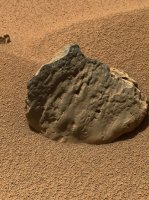
Et-Then

29 Oct. 2012 - Rock 'Et-Then' Near Curiosity, Sol 82
The Mars Hand Lens Imager (MAHLI) on the arm of NASA's Mars rover Curiosity took this image of a rock called "Et-Then" during the mission's 82nd sol, or Martian day (Oct. 29, 2012.)

The rock's informal name comes from the name of an island in Great Slave Lake, Northwest Territories, Canada.

MAHLI viewed the rock from a distance of about 40 cm. The image covers an area about 24 cm by 18 cm.

Image Credit: NASA/JPL-Caltech/MSSS
 

Anhänge

  • pia16236_MAHLI_Sol82_Et-The.jpg
    pia16236_MAHLI_Sol82_Et-The.jpg
    99,5 KB · Aufrufe: 2.884
MSL - First X-Ray Diffraction Analysis

First X-ray View of Martian Soil

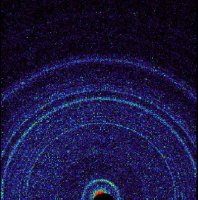
This graphic shows results of the first analysis of Martian soil by the Chemistry and Mineralogy (CheMin) experiment on NASA's Curiosity rover. The image reveals the presence of crystalline feldspar, pyroxenes and olivine mixed with some amorphous (non-crystalline) material. The soil sample, taken from a wind-blown deposit within Gale Crater, where the rover landed, is similar to volcanic soils in Hawaii.

Curiosity scooped the soil on Oct. 15, 2012, the 69th sol, or Martian day, of operations. It was delivered to CheMin for X-ray diffraction analysis on October 17, 2012, the 71st sol. By directing an X-ray beam at a sample and recording how X-rays are scattered by the sample at an atomic level, the instrument can definitively identify and quantify minerals on Mars for the first time. Each mineral has a unique pattern of rings, or "fingerprint," revealing its presence.

The colors in the graphic represent the intensity of the X-rays, with red being the most intense.

Image credit: NASA/JPL-Caltech/Ames


Anhänge

  • 701711main_Bish-1-pia16217-.jpg
    701711main_Bish-1-pia16217-.jpg
    98,8 KB · Aufrufe: 2.845
Analyse der Atmosphäre

Jetzt gibt's auch erste Untersuchungen der Atmosphäre:

NASA Rover Finds Clues to Changes in Mars' Atmosphere

Kohlenstoff: Das Isotopenverhältnis von Kohlenstoff wurde mit einem Massenspektrometer untersucht und mit der erwarteten Ausgangssituation bei der Bildung des Planeten vor einigen Milliarden Jahren verglichen. Anscheinend sind die leichteren Isotopenanteile um etwa 5% vermindert. Man schließt daraus, dass der fehlende Anteil im Laufe der Entwicklung der Atmosphäre allmählich in den Weltraum entwichen ist.

Methan: Trotz der beträchtlichen Empfindlichkeit der Nachweisgeräte von wenigen 10^-9, wurde bislang kein signifikantes CH4-Signal registriert.

 
SAM

Na denn mal guten Appetit ...

Inlet Covers for Sample Analysis at Mars

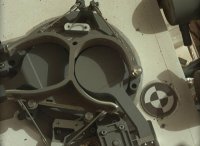
This subframe image from the left Mast Camera (Mastcam) on NASA's Mars rover Curiosity shows the covers in place over two sample inlet funnels of the rover's Sample Analysis at Mars (SAM) instrument suite.

Image Credit: NASA/JPL-Caltech/MSSS
 

Anhänge

  • pia16446-Sol93-LMastcam-SAM.jpg
    pia16446-Sol93-LMastcam-SAM.jpg
    74,5 KB · Aufrufe: 2.565
Re: SAM

Wie es aussieht leider nicht.
"There's out of control parroting regarding Mars Curiosity. The "one for the history books" refers to the mission, not any one new discovery." wurde via Twitter von Bob Jacobs, NASA Deputy Associate Administrator, Office of Communications, verbreitet.

Bob Jacobs auf Twitter
 
Und sie bewegt sich doch!

Am 18. November gings endlich mal wieder weiter.
Etwa 35 Meter immerhin.

Emily Lakdawalla schrieb dazu ein recht aufschlussreiches Update.

Sonnige Grüsse vom MittelMeerDobservatorio
Thorsten

PS: "One for the history books", schade dass da nix
spektakuläres kommt, ich dachte schon, sie hätten
mal wieder Arsen-fressende (pardon, Peroxid natürlich!)
Bakterien gefunden... :pfeif:
 
Re: SAM

Sky & Telescope - a Whiff of Organic Matter

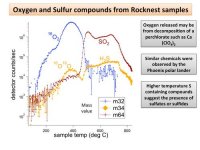
SAM found that the powder from Rocknest released water vapor, oxygen, and sulfur dioxide when heated. But that's nothing new — these results match the compositions of the dust found elsewhere on Mars by previous rovers and landers. Still, notes Paul Mahaffy, principal investigator for SAM, "We consider this a terrific milestone." The water vapor, for example, probably came from hydrated minerals like clays.

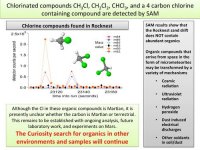
The instrument did identify some simple organic molecules, variations of methane (CH4) in which chlorine atoms have substituted for one or more hydrogen atoms. But there's a huge caveat: it's very unlikely that chlorinated methane actually exists on Mars. Instead, SAM's tiny ovens probably caused perchlorate molecules (found commonly in martian dirt) to release lots of chlorine and oxygen as they broke down.

"We have no definitive detection of Martian organics at this point," Mahaffy says. It's not clear yet where the carbon comes from — perhaps it's derived from carbonates in the Rocknest sample, or it could be traces of carbon-based contamination carried from Earth.

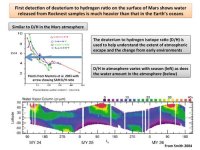
Potentially more interesting is SAM's determination that the derived water vapor is highly enriched in hydrogen's "heavy" isotope, deuterium. The D:H ratio is more than five times that in Earth's seawater. The thinking goes that, over the eons of history, molecules of water vapor have been broken down by ultraviolet sunlight high in the Martian atmosphere, and the lighter hydrogen atoms have preferentially escaped to space. In principle, this five-fold deuterium enrichment can be used to figure out just much water has been lost. It's also possible that Curiosity will eventually unearth a sample of "old" water — locked up in an ancient rock layer, to reveal how the atmosphere has evolved over time.


Image Credit: NASA/JPL
 

Anhänge

  • Edgett-2-pia16469_unannotated-br.jpg
    Edgett-2-pia16469_unannotated-br.jpg
    47,5 KB · Aufrufe: 2.415
  • Mahaffy-1-pia16573-br.jpg
    Mahaffy-1-pia16573-br.jpg
    42,9 KB · Aufrufe: 2.400
  • Mahaffy-2-pia16574-br.jpg
    Mahaffy-2-pia16574-br.jpg
    43,6 KB · Aufrufe: 2.426
Re: SAM

... und noch mehr Chemie

Image Credit: NASA/JPL
 

Anhänge

  • Mahaffy-3-pia16575-br.jpg
    Mahaffy-3-pia16575-br.jpg
    39 KB · Aufrufe: 2.376
  • Mahaffy-4-pia16576-br.jpg
    Mahaffy-4-pia16576-br.jpg
    52,2 KB · Aufrufe: 2.370
MSL Kilometerstand 0,598

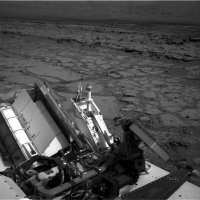
The route took the rover close to an outcrop called "Shaler," where scientists used Curiosity's Chemistry and Camera (ChemCam) instrument and Mast Camera (Mastcam) to assess the rock's composition and observe its layering.

Image Credit: NASA/JPL-Caltech/MSSS
 

Anhänge

  • pia16550-Fig1_Shaler.jpg
    pia16550-Fig1_Shaler.jpg
    95,4 KB · Aufrufe: 2.275
km 0,677 +

Holiday Break at Yellowknife Bay

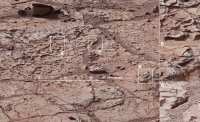
On Dec. 14, Curiosity drove about 33 meters to reach rock targets of interest called "Costello" and "Flaherty." Researchers used the Alpha Particle X-Ray Spectrometer (APXS) and Mars Hand Lens Imager (MAHLI) at the end of the rover's arm to examine the targets. After finishing those studies, the rover drove again on Dec. 17, traveling about 6 meters farther into Yellowknife Bay. That brings the mission's total driving distance to 677 meters since Curiosity's landing.

One additional drive is planned this week before the rover team gets a holiday break. Curiosity will continue studying the Martian environment from its holiday location at the end point of that drive within Yellowknife Bay.


Image Credit: NASA/JPL-Caltech/MSSS
 

Anhänge

  • PIA16553.jpg
    PIA16553.jpg
    98,5 KB · Aufrufe: 2.201

Anhänge

  • PIA16701-WhiteBal-br2.jpg
    PIA16701-WhiteBal-br2.jpg
    98,3 KB · Aufrufe: 1.982
  • pia16567annotated-br2.jpg
    pia16567annotated-br2.jpg
    98,1 KB · Aufrufe: 2.027
  • pia16568unannotated-br2.jpg
    pia16568unannotated-br2.jpg
    99,6 KB · Aufrufe: 1.996
Re: ISON vom Mars aus

Und noch was ulkiges,
ein animiertes Video,
wo der Rover die letzten Wochen
so rumgegurkt ist. => Klik!

Wie lange dauert es wohl noch,
bis sie endlich den Bohrer ansetzen? :gutefrage:

Sonnige Grüsse vom MittelMeerDobservatorio
Thorsten
 
MSL Bohrer

Und ein pdf, das den Bohrer des MSL
bis wirklich ins letzte Detail erklärt.

Es scheint, dass demnäxt endlich gebohrt wird...

Gruss
Thorsten
 
Re: MSL Bohrer

Und die erste "Bohrung" ist gemacht.
Wobei man das wohl nicht "Bohrung" nennen kann,
sonder eher ein "Hämmern", da es sich um einen
Schlagbohrer handelt, der bei den ersten Versuchen
nur "schlägt" (hämmert) aber sich noch nicht dreht (bohrt).

Hier aus dem UMSF ein etwas nervöses
Vorher-Nachher-gif der Bohr-, pardon, Hämmerstelle.

Und es gibt offenbar schon zwei Probestellen.
Hier ein ganz netter fotografischer Vergleich.

Sonnige Grüsse vom MittelMeerDobservatorio
Thorsten
 

Anhänge

  • pia16717_MAHLI_Sol176.jpg
    pia16717_MAHLI_Sol176.jpg
    99,4 KB · Aufrufe: 1.744
Zuletzt von einem Moderator bearbeitet:
Erste Bohrprobe

Rover Collects First Martian Bedrock Sample

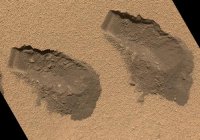
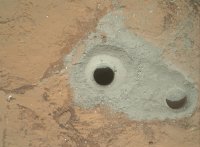
In der Bildmitte befindet sich die Stelle, wo nach mehreren Vorversuchen nun endlich die erste richtige Bohrprobe entnommen wurde. Das Bohrloch hat einen Durchmesser 16 mm und eine Tiefe von 64 mm. Das flachere Bohrloch rechts daneben ist eine von den vorangegangenen Testbohrungen.

Rock powder generated during drilling travels up flutes on the bit. The bit assembly has chambers to hold the powder until it can be transferred to the sample-handling mechanisms of the rover's Collection and Handling for In-Situ Martian Rock Analysis (CHIMRA) device.

Before the rock powder is analyzed, some will be used to scour traces of material that may have been deposited onto the hardware while the rover was still on Earth, despite thorough cleaning before launch.


Image Credit: NASA/JPL-Caltech/MSSS
 

Anhänge

  • PIA16726.jpg
    PIA16726.jpg
    99,2 KB · Aufrufe: 1.615
Link zur Grafik: http://scr3.golem.de/screenshots/1302/Curiosity_Objekt/thumb620/0173MR0926020000E1_DXXX.jpg
Auf einem Foto, das der Rover Curiosity von der Marsoberfläche aufgenommen hat, ist ein glänzender Gegenstand zu sehen, der aus dem Gestein ragt. Die italienische Bloggerin Elisabetta Bonora hat das Foto in den Archiven der Nasa entdeckt. Es wurde am 30. Januar 2013 aufgenommen. Die Nasa hat das Foto noch nicht kommentiert.
http://www.golem.de/news/curiosity-glaenzendes-objekt-auf-mars-foto-entdeckt-1302-97493.html
 
Zuletzt von einem Moderator bearbeitet:
Inzwischen gibt's einen Kommentar von der NASA dazu:
Mars Rock Takes Unusual Form

Den Link dort hab ich allerdings nur grob überflogen,
bin also nicht sicher, ob er das Bild zufrieden stellend erklärt.

Ein Stereobild wäre nützlich, aber das gibt es wohl
von der Stelle (noch) keines.

Gruss
Thorsten
 
Hallo zusammen,

eben habe ich im Radio gehört Curiosity würde wegen Computerproblemen vorrübergehend abgeschaltet. Hoffentlich kriegen die das wieder hin. Ich hatte bisher nichts davon gehört, dass es da Probleme gab. Wäre sehr schade wenn es nicht weiter ginge.


CS

Joachim
 
Status
Es sind keine weiteren Antworten möglich.
Zurück
Oben