Messenger: Die Merkur-Sonde nach Mariner 10

Status
Es sind keine weiteren Antworten möglich.

Anhänge

  • EW0242837980G_3band_mapped.jpg
    EW0242837980G_3band_mapped.jpg
    99,3 KB · Aufrufe: 2.480
  • EW0245065935G_3band_mapped.jpg
    EW0245065935G_3band_mapped.jpg
    98,5 KB · Aufrufe: 2.523
  • EW0210935622G_3band_mapped.jpg
    EW0210935622G_3band_mapped.jpg
    99,8 KB · Aufrufe: 2.502
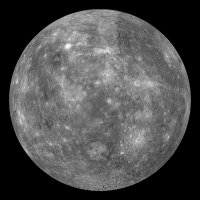
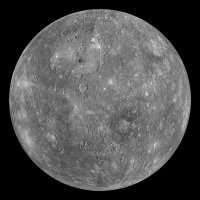
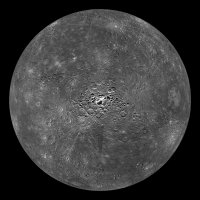
Merkur global

0°N, 0°E

0°N, 90°E

Image Credit: NASA/Johns Hopkins University Applied Physics Laboratory/Carnegie Institution of Washington
 

Anhänge

  • 0deg_0E_combined_basemap_25.jpg
    0deg_0E_combined_basemap_25.jpg
    96,9 KB · Aufrufe: 2.144
  • 0deg_90E_combined_basemap_2.jpg
    0deg_90E_combined_basemap_2.jpg
    96,6 KB · Aufrufe: 2.210
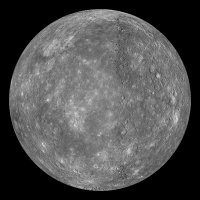
Merkur global

0°N, 180°E

0°N, 270°E

Image Credit: NASA/Johns Hopkins University Applied Physics Laboratory/Carnegie Institution of Washington
 

Anhänge

  • 0deg_180E_combined_basemap_.jpg
    0deg_180E_combined_basemap_.jpg
    96,5 KB · Aufrufe: 2.187
  • 0_deg_270E_combined_basemap.jpg
    0_deg_270E_combined_basemap.jpg
    95,8 KB · Aufrufe: 2.350
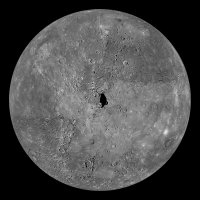
Merkur global

North Pole

South Pole

Image Credit: NASA/Johns Hopkins University Applied Physics Laboratory/Carnegie Institution of Washington
 

Anhänge

  • North_Pole_combined_basemap.jpg
    North_Pole_combined_basemap.jpg
    98,3 KB · Aufrufe: 2.334
  • South_Pole_combined_basemap.jpg
    South_Pole_combined_basemap.jpg
    98,3 KB · Aufrufe: 2.254
Vulkanismus auf Merkur

Vulkanismus auf Merkur

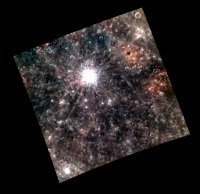
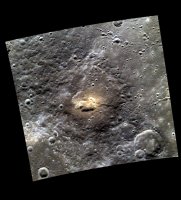
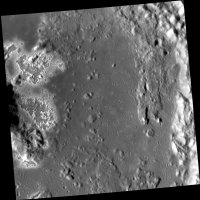
Caloris Impact Basin (1)

The prominent reddish spots are associated with irregular depressions that are thought to be volcanic vents. The reddish deposits are probably formed of pyroclastic material ejected from the vents during explosive eruptions.

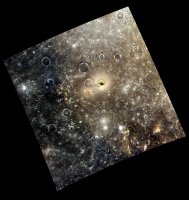
Caloris Impact Basin (2)

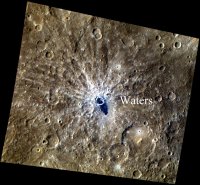
In the center of the image is a kidney-shapped depression that is surrounded by a halo of lighter material. This feature ... is thought to be a volcanic vent.

Image Credit: NASA/Johns Hopkins University Applied Physics Laboratory/Carnegie Institution of Washington
 

Anhänge

  • EW0218203149I_pho_996-559-4.jpg
    EW0218203149I_pho_996-559-4.jpg
    99,6 KB · Aufrufe: 2.133
  • kidney_color.jpg
    kidney_color.jpg
    98,6 KB · Aufrufe: 2.103
Vulkanismus auf Merkur

Vulkanismus auf Merkur

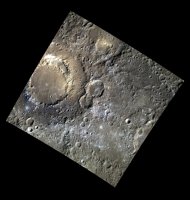
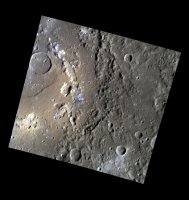
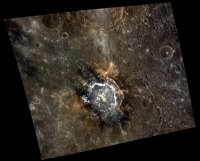
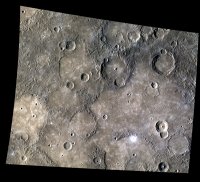
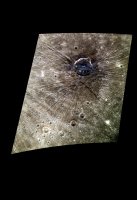
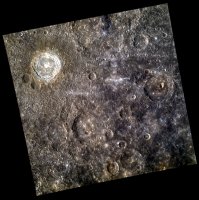
Scarlatti

The first image shows the peak-ring basin Scarlatti in color. The bright, irregular depression on the interior ring of the basin is thought to be a volcanic vent. There are also hollows present in the southern section of the peak-ring that appear blue compared to the surrounding material.

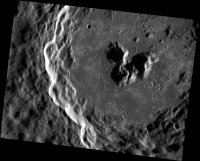
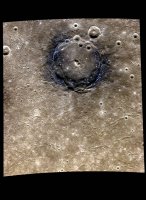
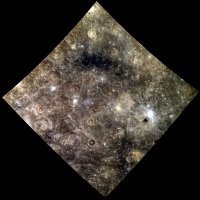
Another vulcanic vent

The second image shows an unnamed, heavily degraded crater with a volcanic vent at the center, visible as an irregular, rimless depression.

Image Credit: NASA/Johns Hopkins University Applied Physics Laboratory/Carnegie Institution of Washington
 

Anhänge

  • EW0242004043G_3band_mapped.jpg
    EW0242004043G_3band_mapped.jpg
    99,1 KB · Aufrufe: 2.072
  • EW0210808081G_3band_mapped.jpg
    EW0210808081G_3band_mapped.jpg
    100 KB · Aufrufe: 2.042
the colors of Mercury

Indigo Eyes

The human eye is sensitive to light with wavelengths from about 400 to 700 nanometers (nm). We perceive light from the short-wavelength end of this spectrum as violet or indigo. Today's image was taken through a filter with a center wavelength of 433 nm, corresponding to these indigo colors. Named craters in the scene include Zeami, Rublev, and the Tolstoj basin.

Red vs. Blue

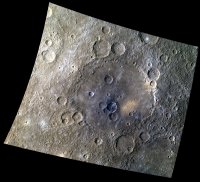
This enhanced-color scene lies on the edge of Praxiteles, a peak-ring basin approximately 200 km in diameter. The high-reflectance, redder areas are irregularly shaped pits likely formed by volcanic activity, and the high-reflectance, bluer areas are hollows. Pits and hollows are often found together on Mercury. Their relationship to one another is the subject of ongoing investigation by the MESSENGER team.

Credit: NASA/Johns Hopkins University Applied Physics Laboratory/Carnegie Institution of Washington
 

Anhänge

  • EW0232625123F.jpg
    EW0232625123F.jpg
    99,3 KB · Aufrufe: 2.036
  • EW0253964964G.jpg
    EW0253964964G.jpg
    99,5 KB · Aufrufe: 2.017
the colors of Mercury

Red Rocks, Blue Rocks

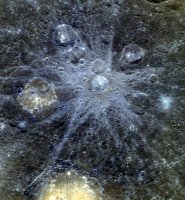
This complex crater was recently named to honor Theodor Seuss Geisel, better known as Dr. Seuss. Seuss crater is relatively fresh, its floor contains impact melt and hollows, and the impact has excavated materials with different color characteristics. These characteristics make the crater very interesting, slightly odd, and colorful in appearance, much like Seuss's illustrations.

Volcanic Plains

Many regions of Mercury's surface are comprised of relatively red and smooth terrain that appears to flood low-lying regions and partially fill or bury older craters. These smooth plains are thought to have been formed by volcanic activity that drowned the region in voluminous, low-viscosity lavas.

Credit: NASA/Johns Hopkins University Applied Physics Laboratory/Carnegie Institution of Washington
 

Anhänge

  • EW0222190044G.jpg
    EW0222190044G.jpg
    99,7 KB · Aufrufe: 1.982
  • EW0251402350G.jpg
    EW0251402350G.jpg
    99,1 KB · Aufrufe: 1.962
Hollows of Mercury

de Graft

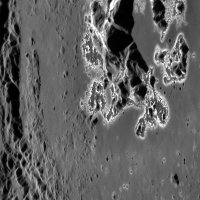
De Graft, a complex crater that contains many hollows on its floor and peak. It is not yet known exactly how hollows form, but the MESSENGER team is actively working to understand this unique phenomenon. Pristine hollows in young craters like de Graft may be still forming to this day.

A Closer Look at Eminescu

Eminescu is already of interest due to the spectacular hollows on its floor and peaks. This image highlights the interesting range of textures on Eminescu's floor.

Central Peaks of Eminescu

The central peaks of Eminescu are revealed here at high resolution, showing off an impressive collection of hollows. Some of these hollows have coalesced into larger formations.

Credit: NASA/Johns Hopkins University Applied Physics Laboratory/Carnegie Institution of Washington
 

Anhänge

  • EN0250938380M.jpg
    EN0250938380M.jpg
    99,9 KB · Aufrufe: 1.980
  • EN0251545743M.jpg
    EN0251545743M.jpg
    99,4 KB · Aufrufe: 1.892
  • EN0231610992M.jpg
    EN0231610992M.jpg
    95,8 KB · Aufrufe: 1.957
Messenger Update

Raphael

Instrument: Wide Angle Camera (WAC) of the Mercury Dual Imaging System (MDIS)
WAC filters: 9, 7, 6 (996, 748, 433 nanometers) in red, green, and blue
Center Latitude: -20.39°
Center Longitude: 283.6° E
Resolution: 599 meters/pixel
Scale: Raphael is 342 kilometers in diameter.

This colorful image of the impact basin Raphael shows a diversity of compositions within the volcanic plains that flooded the basin's floor. Hollows appear to be forming in the low reflectance material within the smaller, roughly 40-kilometer diameter complex crater just south of the center of the basin.


Suisei Planitia

Instrument: Mercury Dual Imaging System (MDIS)
Center Latitude: 62°
Center Longitude: 212° E
Map Projection: Equidistant Cylindrical
Scale: The double-ring basin in the lower right is Strindberg, about 189 kilometers in diameter.

On the Moon, areas of smooth plains are called "maria", plural of the Latin word "mare", for "sea". For example, Mare Imbrium is the Sea of Rains. After Mariner 10 obtained the first spacecraft images of Mercury in the mid-1970s, seven areas of smooth plains were given names. However, they were named "planitia", not "maria". Today's release is a mosaic of MESSENGER images centered on Suisei Planitia. Suisei is the Japanese word for the planet Mercury.

Credit: NASA/Johns Hopkins University Applied Physics Laboratory/Carnegie Institution of Washington
 

Anhänge

  • EW0259122580G_Raphael.jpg
    EW0259122580G_Raphael.jpg
    99,6 KB · Aufrufe: 2.035
  • Suisei_planitia.jpg
    Suisei_planitia.jpg
    98,9 KB · Aufrufe: 2.129
Eis auf Merkur

Schon lange wurde darüber spekuliert, ob es trotz der sengenden Hitze von bis zu 430°C auf Merkur möglicherweise an den Polargebieten abgeschattete Krater mit Wassereis geben könnte. Vor gut zwanzig Jahren gab es dann erste konkrete Hinweise darauf:

In 1991, planetary scientists Duane Muhleman and Bryan Butler from Caltech and Martin Slade from the Jet Propulsion Laboratory, studied Mercury using a radar system consisting of a 70-meter dish antenna at Goldstone, CA, equipped with a half-million-watt transmitter, and the VLA as the receiving system. The beam of 8.5-GHz microwaves sent from Goldstone bounced off Mercury and was collected at the VLA to produce a radar image of the planet. The resulting radar image contained a stunning surprise. The strong reflection seen on Mercury is too large to be caused by a momentary "glint" off a crater wall, and when studied in more detail shares the characteristics of reflections from the water ice seen on Mars and the icy moons of Jupiter. Scientists now believe that the ice resides on the floors of craters at Mercury's north pole, where it can remain permanently shaded from the Sun and reach temperatures as low as 125 degrees Kelvin.

Messungen mit dem Merkur-Orbiter Messenger haben diese ersten Hinweise nun bestätigt:

Spiegel - Forscher finden tonnenweise Eis auf dem Merkur

Erstaunliche Nachrichten von der Oberfläche des sonnennächsten Planeten Merkur: Die Nasa-Sonde "Messenger" hat Eis in großen Mengen auf dem Planeten nachgewiesen. In drei Studien im Fachmagazin "Science" berichten Nasa-Wissenschaftler von den Belegen für große Eisvorkommen in der Nordpolregion. Diese Seite ist der Sonne stets abgewandt.

"Insgesamt kommen wir auf etwa hundert Milliarden bis zu einer Billion Tonnen Eis", sagt David Lawrence vom Labor für Angewandte Physik der Johns-Hopkins-Universität in Baltimore (Maryland) und Erstautor einer der Studien. Die genaue Menge konnten die Wissenschaftler nicht bestimmen, da sie nicht wissen, wie dick die Eisschicht genau ist. Sie gehen von mindestens 30 Zentimetern aus, möglicherweise erreicht sie aber auch eine Dicke von bis zu 20 Metern.


NASA Science News - New Evidence for Ice on Mercury

Now, the newest data from MESSENGER confirm that water ice is the major constituent of Mercury's north polar deposits. In the coldest places, the ice is exposed on the surface. In slightly warmer spots, some kind of dark insulating material appears to cover the ice.

MESSENGER uses neutron spectroscopy to measure average hydrogen concentrations within Mercury's radar-bright regions. Ice concentrations are derived, in turn, from the hydrogen measurements. This is possible because water, or H2O, is two parts hydrogen.

"The neutron data indicate that Mercury's radar-bright polar deposits contain, on average, a hydrogen-rich layer more than tens of centimeters thick beneath a surficial layer 10 to 20 centimeters thick that is less rich in hydrogen," says Lawrence. "The buried layer has a hydrogen content consistent with nearly pure water ice."

Data from MESSENGER's Mercury Laser Altimeter (MLA) -- which has fired more than 10 million laser pulses at Mercury to make detailed maps of the planet's topography -- corroborate the ice hypothesis, writes Gregory Neumann of the NASA Goddard Flight Center. In a second paper, Neumann and his colleagues report that the first laser measurements of the shadowed north polar regions reveal irregular dark and bright deposits near Mercury's north pole.


The New York Times - On Closest Planet to the Sun, NASA Finds Lots of Ice

Wired Science - Frozen Water and Organic Material Discovered on Mercury


Anhänge

  • EW0258052721G_3band_nomap_v.jpg
    EW0258052721G_3band_nomap_v.jpg
    97,4 KB · Aufrufe: 1.800
  • EW0211111727G_3band_mapped.jpg
    EW0211111727G_3band_mapped.jpg
    99 KB · Aufrufe: 1.834
  • EW0263526430G_3band_mapped.jpg
    EW0263526430G_3band_mapped.jpg
    99,8 KB · Aufrufe: 1.867
Re: Messenger Update

Ein Toast auf Edgar Allen Poe

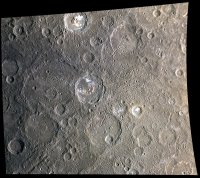
For as long as 70 years, a visitor to the original grave site of Edgar Allan Poe left a tribute in the form of roses and a bottle of cognac each January 19 (Poe's birthday). The "Poe Toaster" has not appeared since 2009, and it appears that the tradition has ended. Here we offer our own toast to the great American writer: a color view of Poe crater on Mercury. In this representation, Poe's raven-colored rim stands out from the tan volcanic plains that surround it.

Credit: NASA/Johns Hopkins University Applied Physics Laboratory/Carnegie Institution of Washington

Poe Toaster

Der Poe Toaster ist eine mysteriöse Gestalt, die jährlich dem verstorbenen amerikanischen Autor Edgar Allan Poe Tribut zollt. Er trägt dabei einen schwarzen Mantel und einen schwarzen Hut; sein Gesicht ist verschleiert.

Die rätselhafte Tradition dieses Poe Toasters wurde zum ersten Mal 1949 von Passanten beobachtet. Seitdem beobachten dies jedes Jahr etliche Besucher von Poes Grab. In den frühen Morgenstunden des Geburtstags von Poe (19. Januar) erscheint ein in Schwarz gehüllter Mensch, betritt die Westminster Hall in Baltimore, Maryland, und geht dann auf den Friedhof und weiter zum Grab. Dort lässt der Poe Toaster drei Rosen und eine kleine Flasche mit Cognac nieder.


Na denn man Prost auf Poe und seinen Krater auf Merkur!

Credit: Wikipedia
 

Anhänge

  • EW0218204190G_3band_mapped.jpg
    EW0218204190G_3band_mapped.jpg
    96,4 KB · Aufrufe: 1.714
  • PoeGrave-withCognac.jpg
    PoeGrave-withCognac.jpg
    98,4 KB · Aufrufe: 1.742
Re: Messenger Update

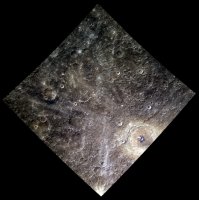
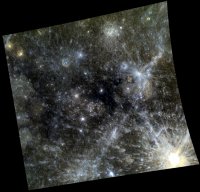
Credit: NASA/Johns Hopkins University Applied Physics Laboratory/Carnegie Institution of Washington
 

Anhänge

  • Kyosai.jpg
    Kyosai.jpg
    98,5 KB · Aufrufe: 1.645
  • Popova.jpg
    Popova.jpg
    96,4 KB · Aufrufe: 1.644
Re: Messenger Update

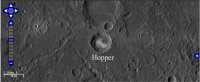
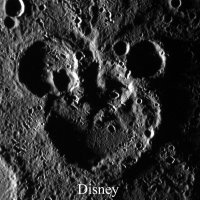
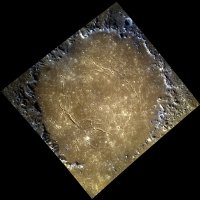
Mickey Mouse Spotted on Mercury!

Und ratet mal, welchen Namen der Krater bekommen hat ...

Credit: NASA/Johns Hopkins University Applied Physics Laboratory/Carnegie Institution of Washington
 

Anhänge

  • Hopper.jpg
    Hopper.jpg
    98,7 KB · Aufrufe: 1.631
  • Disney.jpg
    Disney.jpg
    96,4 KB · Aufrufe: 1.596
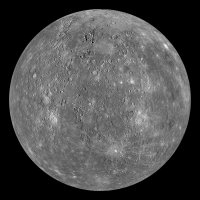
Merkur total

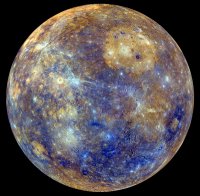
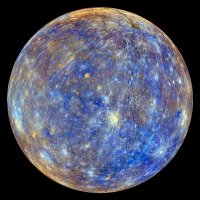
Merkur total –in verstärkten Farben:

This colorful view of Mercury was produced by using images from the color base map imaging campaign during MESSENGER's primary mission. These colors are not what Mercury would look like to the human eye, but rather the colors enhance the chemical, mineralogical, and physical differences between the rocks that make up Mercury's surface.

Young crater rays, extending radially from fresh impact craters, appear light blue or white. Medium- and dark-blue areas are a geologic unit of Mercury's crust known as the "low-reflectance material", thought to be rich in a dark, opaque mineral. Tan areas are plains formed by eruption of highly fluid lavas.


View 1 - Center Longitude: 140° E

View 2 - Center Longitude: 320° E

Credit: NASA/Johns Hopkins University Applied Physics Laboratory/Carnegie Institution of Washington
 

Anhänge

  • enh_color_map_rot_140.jpg
    enh_color_map_rot_140.jpg
    99,7 KB · Aufrufe: 1.571
  • enh_color_map_rot_320.jpg
    enh_color_map_rot_320.jpg
    99,5 KB · Aufrufe: 1.533
Re: Merkur total

Danke für die Updates.

Sind das immernoch alles Bilder der Messenger oder vom Merkur generell?
 
Re: Messenger Update

Ein weiteres Jahr im Orbit und Appetit für mehr:

Messenger Timeline

2004-08-03 ...... Spacecraft launched at 06:15:56 UTC
2005-08-02 ...... Flyby encounter with Earth
2006-10-24 ...... Flyby encounters with Venus
2008-01-14 ...... Flyby encounters with Mercury
2011-03-18 ...... Mercury orbital insertion
2012-03-17 ...... Commencement of extended mission

MESSENGER Completes Its First Extended Mission at Mercury

On March 17, 2013, MESSENGER successfully completed its year-long first extended mission in orbit about Mercury, building on the groundbreaking scientific results from its earlier primary mission. Today the team is poised to embark on a second extended mission that promises to provide new observations of Mercury's surface and interior at unprecedented spatial resolution and of the planet's dynamic magnetosphere and exosphere at high time resolution during the peak and declining phase of the current solar cycle.

"NASA is currently considering a second extension to mission operations and until the formal decision is made has asked that we continue to operate the spacecraft and its scientific instruments," says MESSENGER Project Manager Helene Winters of the Johns Hopkins University Applied Physics Laboratory (APL) in Laurel, Maryland.


Re: Messenger Update

Betr.: Merkurs Nordpol

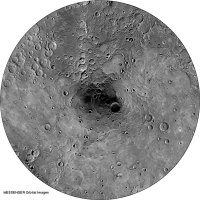
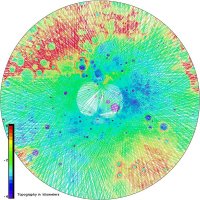
Am Nordpol von Merkur gab es noch eine kleine Enklave, die von den Kameras von Messenger zunächst nicht oder nur unter ungünstigen Lichtverhältnissen erfasst werden konnte. Inzwischen wurde auch diese obskure 'Terra Incognita' als Mosaik zahlreicher Einzelaufnahmen und aus Laser-Altimeterdaten rekonstruiert. In das Innere der dort befindlichen Krater fällt nie ein Sonnenstrahl, so dass sich dort sogar große Mengen von Eis halten können.

Orbital Mosaic of Mercury's North Pole

Instrument: Wide Angle Camera (WAC) of the Mercury Dual Imaging System (MDIS)
Center Latitude: 90° N
Map Projection: Polar stereographic projection, extending southward to 65° N, with 0° longitude at the bottom
Scale: The diameter of this polar map projection covers 2,130 kilometers


Höhenprofil (Laser-Altimeter)

Nomenklatur

Image Credit: NASA/Johns Hopkins University Applied Physics Laboratory/Carnegie Institution of Washington
 

Anhänge

  • North-Pole_a.jpg
    North-Pole_a.jpg
    98,6 KB · Aufrufe: 1.539
  • North-Pole_b.jpg
    North-Pole_b.jpg
    98,3 KB · Aufrufe: 1.498
Re: Messenger Update

Bei all dem Hoopla über das Erd-Portrait von Cassini ist weitgehend untergegangen, dass ähnliches auch aus der inneren Perspektive des Sonnensystems, nämlich von Messenger am Merkur durchgeführt wurde:

MESSENGER to Capture Images of Earth and Moon During Search for Satellites of Mercury

NASA's Mercury-orbiting MESSENGER spacecraft will capture images of Earth on July 19 and 20. The images will be taken at 7:49 a.m., 8:38 a.m. and 9:41 a.m. EDT on both days. Nearly half of the Earth, including all the Americas, Africa, and Europe, will be illuminated and facing MESSENGER, according to Hari Nair, the Johns Hopkins University Applied Physics Laboratory planetary scientist who designed and is implementing the campaign. The images on the second day will also include pictures of the Moon, where all six of the Apollo landing sites will be illuminated, 44 years to the day after Apollo 11 landed on the Moon's rocky surface.

Trotz der wesentlich kleineren Entfernung, werden aber auch auf den Messenger Portraits von Erde und Mond keine Details zu erkennen sein:

"It's important to note that the Earth and Moon are going to be less than a pixel in size, and so no details will be seen," Nair cautioned. "In practice, all we're going to see are two bright dots."

Und hier ist das Ergebnis: Looking Back at Us

So ein ähnliches Bild wurde schon einmal aufgenommen, als die Sonde am 8. Mai 2010 noch im Anflug auf Merkur war:

Erde in Oppsotion

Dabei sind wegen der Überbelichtung die Größe von Erde und Mond im Vergleich zu ihrem Abstand stark übertrieben. Das neue Bild zeigt bei näherer Betrachtung wegen der Überbelichtung sogar unschöne CCD-Artefakte (Blooming).

Der wissenschaftliche Wert solcher Bilder ist sicherlich kaum der Rede wert, gleichwohl vermitteln sie eine starke Botschaft zu den Entfernungen zwischen den Himmelskörpern, selbst in unserer unmittelbaren Nachbarschaft.

Credit: NASA/Johns Hopkins University Applied Physics Laboratory/Carnegie Institution of Washington
 

Anhänge

  • EW1016558881.jpg
    EW1016558881.jpg
    62 KB · Aufrufe: 1.361
Re: Messenger Update

Hallo Peter,

was Du jetzt allerdings etwas unterschlagen hast :

Diese Aufnahmen wurden nicht etwa deshalb angefertigt, um parallel zu Cassini eine "schön anzuschauende" Aufnahme von Erde und Mond zu erstellen. Der Hintergrund war vielmehr durchaus wissenschaftlicher Natur!
Seit dem Februar 2013 sucht Messenger bei passenden Gelegenheiten nach bisher unbekannten Merkur-Monden, welche - sofern überhaupt vorhanden - bestenfalls wenige Kilometer durchmessen können, und bildet dabei die Umgebung des Merkur mit der MDIS-Kamera des Orbiters ab. Am 19. und 20. Juli geriet dabei zufällig auch das Erde-Mond-System in den Aufnahmebereich der Kamera...
Schöne Grüße aus Hamburg - Mirko
 
Re: Messenger Update

Ein gewisser Zufall war es schon, denn der Merkur hat zur Erde-Sonne Ekliptik eine maximale Inklination von 7º und in dieser Ebene werden auch die möglichen Planetoiden liegen, dadurch war es schon ein Zufall, oder natürlich gut berechnete Absicht, dass die Erde auf dem Bild ist.
 
Re: Messenger Update

Zitat von FelixW:
Ein gewisser Zufall war es schon, denn der Merkur hat zur Erde-Sonne Ekliptik eine maximale Inklination von 7º und in dieser Ebene werden auch die möglichen Planetoiden liegen, dadurch war es schon ein Zufall, oder natürlich gut berechnete Absicht, dass die Erde auf dem Bild ist.
Verstehe aber nicht, was die Blickrichtung zur Erde am 19./20. Juli in besonderer Weise für die Suche nach Satelliten begünstigen würde. Dass Merkur keinen größeren Satelliten besitzt, weiß man ja schon. Bleiben also allenfalls eingefangene Trümmer aus dem Asteroidengürtel. Die Bahnneigungen dieser Objekte gegenüber der Ekliptik haben aber eine enorme Streuung innerhalb von ±20° und teilweise sogar mehr, so dass man auch weit außerhalb dieser Ebene suchen müsste.

Mercury's Moon

April Fool's Moon

 
Re: Messenger Update

Das stimmt, ich habe bei meiner Antwort nicht berücksichtigt, dass ein möglicher Satellit, sofern vorhanden, sehr geringe Größe haben müsste da er ja sonst vorher bereits endeckt worden wäre. Und diese kleinen Brocken haben in der Tat eine große Streuung in der Bahnneigung.
 
Status
Es sind keine weiteren Antworten möglich.
Zurück
Oben