P_E_T_E_R
Aktives Mitglied
Kepler-62
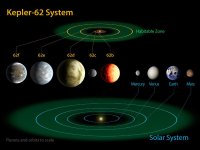
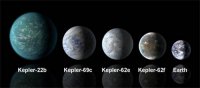
Das vom Kepler-Team gerade bekanntgegebene neue System Kepler-62 hat ein Zentralgestirn vom Spektraltyp K2 mit 0.69 ± 0.02 Sonnenmassen und gleich 5 Planeten. Die beiden äußeren davon, Kepler-62e und Kepler-62f mit einem Bahnradius von 0.43 bzw. 0.72 AU, liegen in der habitablen Zone und könnten unter günstigen Bedingungen Temperaturen für flüssiges Wasser besitzen. Sie sind etwas größer als die Erde, für ihre Massen gibt es aber bislang nur obere Grenzen.
Kepler-62: A Five-Planet System with Planets of 1.4 and 1.6 Earth Radii in the Habitable Zone
Abstract - We present the detection of five planets — Kepler-62b, c, d, e, and f — of size 1.31, 0.54, 1.95, 1.61 and 1.41 Earth radii (R⊕), orbiting a K2V star at periods of 5.7, 12.4, 18.2, 122.4, and 267.3 days, respectively. The outermost planets (Kepler-62e and -62f) are super-Earth-size (1.25 < planet radius < 2.0 R⊕) planets in the habitable zone (HZ) of their host star, receiving 1.2 ± 0.2 and 0.41 ± 0.05 times the solar flux at Earth’s orbit. Theoretical models of Kepler-62e and -62f for a stellar age of ~7 Gyr suggest that both planets could be solid, either with a rocky composition or composed of mostly solid water in their bulk.
NASA's Kepler Discovers Its Smallest 'Habitable Zone' Planets to Date
Two of the newly discovered planets orbit a star smaller and cooler than the sun. Kepler-62f is only 40 percent larger than Earth, making it the exoplanet closest to the size of our planet known in the habitable zone of another star. Kepler-62f is likely to have a rocky composition. Kepler-62e, orbits on the inner edge of the habitable zone and is roughly 60 percent larger than Earth.
Kepler-62e was the first of these habitable zone planets identified. Kepler-62f, with an orbital period of 267 days, was later found by Eric Agol, associate professor of astronomy at the University of Washington and co-author of a paper on the discoveries published in the journal Science. The size of Kepler-62f is now measured, but its mass and composition are not. However, based on previous studies of rocky exoplanets similar in size, scientists are able to estimate its mass by association.
NASA Video
The New York Times - 2 Good Places to Live, 1,200 Light-Years Away
Spiegel - Exoplaneten: Forscher spekulieren über Wasserwelten im All
Image credit: NASA Ames/JPL-Caltech
Das vom Kepler-Team gerade bekanntgegebene neue System Kepler-62 hat ein Zentralgestirn vom Spektraltyp K2 mit 0.69 ± 0.02 Sonnenmassen und gleich 5 Planeten. Die beiden äußeren davon, Kepler-62e und Kepler-62f mit einem Bahnradius von 0.43 bzw. 0.72 AU, liegen in der habitablen Zone und könnten unter günstigen Bedingungen Temperaturen für flüssiges Wasser besitzen. Sie sind etwas größer als die Erde, für ihre Massen gibt es aber bislang nur obere Grenzen.
Kepler-62: A Five-Planet System with Planets of 1.4 and 1.6 Earth Radii in the Habitable Zone
Abstract - We present the detection of five planets — Kepler-62b, c, d, e, and f — of size 1.31, 0.54, 1.95, 1.61 and 1.41 Earth radii (R⊕), orbiting a K2V star at periods of 5.7, 12.4, 18.2, 122.4, and 267.3 days, respectively. The outermost planets (Kepler-62e and -62f) are super-Earth-size (1.25 < planet radius < 2.0 R⊕) planets in the habitable zone (HZ) of their host star, receiving 1.2 ± 0.2 and 0.41 ± 0.05 times the solar flux at Earth’s orbit. Theoretical models of Kepler-62e and -62f for a stellar age of ~7 Gyr suggest that both planets could be solid, either with a rocky composition or composed of mostly solid water in their bulk.
NASA's Kepler Discovers Its Smallest 'Habitable Zone' Planets to Date
Two of the newly discovered planets orbit a star smaller and cooler than the sun. Kepler-62f is only 40 percent larger than Earth, making it the exoplanet closest to the size of our planet known in the habitable zone of another star. Kepler-62f is likely to have a rocky composition. Kepler-62e, orbits on the inner edge of the habitable zone and is roughly 60 percent larger than Earth.
Kepler-62e was the first of these habitable zone planets identified. Kepler-62f, with an orbital period of 267 days, was later found by Eric Agol, associate professor of astronomy at the University of Washington and co-author of a paper on the discoveries published in the journal Science. The size of Kepler-62f is now measured, but its mass and composition are not. However, based on previous studies of rocky exoplanets similar in size, scientists are able to estimate its mass by association.
NASA Video
The New York Times - 2 Good Places to Live, 1,200 Light-Years Away
Spiegel - Exoplaneten: Forscher spekulieren über Wasserwelten im All
Image credit: NASA Ames/JPL-Caltech