Kepler vs Corot

Status
Es sind keine weiteren Antworten möglich.
Kepler-62

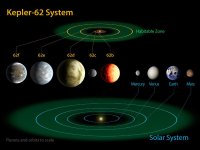
Das vom Kepler-Team gerade bekanntgegebene neue System Kepler-62 hat ein Zentralgestirn vom Spektraltyp K2 mit 0.69 ± 0.02 Sonnenmassen und gleich 5 Planeten. Die beiden äußeren davon, Kepler-62e und Kepler-62f mit einem Bahnradius von 0.43 bzw. 0.72 AU, liegen in der habitablen Zone und könnten unter günstigen Bedingungen Temperaturen für flüssiges Wasser besitzen. Sie sind etwas größer als die Erde, für ihre Massen gibt es aber bislang nur obere Grenzen.

Kepler-62: A Five-Planet System with Planets of 1.4 and 1.6 Earth Radii in the Habitable Zone

Abstract - We present the detection of five planets — Kepler-62b, c, d, e, and f — of size 1.31, 0.54, 1.95, 1.61 and 1.41 Earth radii (R⊕), orbiting a K2V star at periods of 5.7, 12.4, 18.2, 122.4, and 267.3 days, respectively. The outermost planets (Kepler-62e and -62f) are super-Earth-size (1.25 < planet radius < 2.0 R⊕) planets in the habitable zone (HZ) of their host star, receiving 1.2 ± 0.2 and 0.41 ± 0.05 times the solar flux at Earth’s orbit. Theoretical models of Kepler-62e and -62f for a stellar age of ~7 Gyr suggest that both planets could be solid, either with a rocky composition or composed of mostly solid water in their bulk.

NASA's Kepler Discovers Its Smallest 'Habitable Zone' Planets to Date

Two of the newly discovered planets orbit a star smaller and cooler than the sun. Kepler-62f is only 40 percent larger than Earth, making it the exoplanet closest to the size of our planet known in the habitable zone of another star. Kepler-62f is likely to have a rocky composition. Kepler-62e, orbits on the inner edge of the habitable zone and is roughly 60 percent larger than Earth.

Kepler-62e was the first of these habitable zone planets identified. Kepler-62f, with an orbital period of 267 days, was later found by Eric Agol, associate professor of astronomy at the University of Washington and co-author of a paper on the discoveries published in the journal Science. The size of Kepler-62f is now measured, but its mass and composition are not. However, based on previous studies of rocky exoplanets similar in size, scientists are able to estimate its mass by association.


NASA Video

The New York Times - 2 Good Places to Live, 1,200 Light-Years Away

Spiegel - Exoplaneten: Forscher spekulieren über Wasserwelten im All

Image credit: NASA Ames/JPL-Caltech
 

Anhänge

  • Kepler-62-Diagram.jpg
    Kepler-62-Diagram.jpg
    95,3 KB · Aufrufe: 2.658
Re: Kepler-kaputt !?!

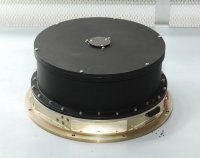
Sieht in der Tat nicht gut aus. Zur kritischen Lagestabilisierung des Schmidt-Teleskops braucht Kepler drei RCWs = Reaction Controlled Wheels , das sind gyroskopische Schwungräder (Flywheels). Von insgesamt vier sind jetzt nur noch zwei funktionsfähig. Das jetzt ausgefallene Rad zeigte schon im Januar auffällige Reibungsverluste.

Kepler Goes Down — and Probably Out

The loss of a flywheel-like device to ensure precise pointing means that NASA's planet-hunting telescope has perhaps made its last observations.


Re: Kepler-kaputt !?!

Ein paar Updates nach dem traumatischen Schwungradverlust vor einem Monat. Kepler wurde erst mal in einen sicheren Ruhezustand (Point Rest State) versetzt, wo es bei minimalen Treibstoffverbrauch erst mal warten kann. Derweil wurde ein 'Anomaly Response Team' zusammengestellt.

Kepler Mission Manager Update - 05.21.2013

Kepler Mission Manager Update - 06.07.2013

Following the apparent failure of reaction wheel 4 on May 11, 2013, engineers were successful at transitioning the spacecraft from a Thruster-Controlled Safe Mode to Point Rest State at approximately 3:30 p.m. PDT on Wednesday, May 15, 2013. The spacecraft has remained safe and stable in this attitude and is no longer considered to be in a critical situation.

PRS was developed in order to preserve fuel for an eventual recovery effort once a second wheel failed. This state uses thrusters to control the pointing of the spacecraft, tipping it towards the sun and letting the solar pressure tip it back away, resembling the motion of a pendulum. This is a very fuel-efficient mode, and it also provides an on-demand telemetry link to allow engineers to monitor and command the spacecraft. With nearly a week of PRS operations, the fuel usage appears to be on the low end of our estimates, allowing time for recovery planning.

Over the coming weeks, an anomaly response team (ART) will evaluate wheel recovery options. The ART includes members from NASA Ames, Ball Aerospace, the Jet Propulsion Laboratory and UTC, the wheel manufacturer. This team has access to a broader reach of experts throughout NASA and industry, and will manage the wheel recovery efforts.

This team has already identified a number of tests to run on the malfunctioning wheels to assess the degree of stiction and the likelihood of freeing a wheel. They are working with the mission engineers to develop and test the commands on the spacecraft test bed located at Ball Aerospace in Boulder, Colo. It will likely be several weeks before they are ready to implement the commands on the reaction wheels aboard the spacecraft. We will continue to provide updates on significant changes as these plans develop and mature.


Corot ist tot

Erst Kepler und nun auch noch COROT - aber tatsächlich war es sogar umgekehrt, denn Corot meldet sich schon seit November gar nicht mehr und wurde jetzt erst offiziell aufgegeben:

COROT Mission Ends

The COROT (Convection, Rotation, and planetary Transits) satellite actually stopped sending data last November. Since then, engineers have been wracking their brains and lab benches for a solution. They finally threw in the towel this month.

The failure’s exact cause remains unknown, but it looks like the converter that delivers power to the onboard computer can’t give the electrical kick needed to restart ...


Re: Corot ist tot

Schade. Allerdings warten ja noch ordentlich Daten von Kepler darauf untersucht zu werden... darin befinden sich bestimmt noch ein paar Schmuckstücke.

Auf alle Fälle hat vor allem Kepler gezeigt, dass es dort draussen nur so wimmelt von Exo-Planeten und unser Sonnensystem wahrscheinlich nichts Außergewöhnliches darstellt. Zukünftige Missionen werden darauf aufbauen und zeigen, dass es Sonnensysteme in erstaunlich vielen Varianten gibt, und zwar um einen Großteil der Sonnen dort draussen. Faszinierend.

Wir leben in einer spannenden Zeit. Ich glaube fest daran, dass innerhalb der nächsten 20 Jahre viele bewohnbare Welten entdeckt werden. Nun muss nur noch jemand den Warp-Antrieb erfinden... ;)
 
Planeten in NGC 6811

Kepler ist ja immer noch kaputt und eine Recovery ist leider eher unwahrscheinlich. Gleichwohl sind bei den bislang gesammelten Daten noch unzählige Kandidaten, die erst nach längerer Analyse und durch unabhängige Beobachtungen bestätigt werden können.

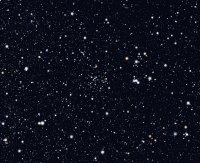
Dazu gehören die jetzt gemeldeten Kepler 66b & 67b, die insofern neu und interessant sind, als ihre jeweiligen Zentralgestirne zu einem offenen Sternhaufen gehören: NGC 6811

The same frequency of planets inside and outside open clusters of stars

In wie weit die Dichte der Sternpopulation und somit die Wahrscheinlichkeit von engen Begegnungen die Formation und langfristige Prognose von Planeten negativ beeinflussen, ist ja Gegenstand einer andauernden Debatte. Insofern sind solche Existenzbeweise natürlich von großem Interesse.

First Transiting Planets in a Star Cluster Discovered

Eine Statistik von zwei gefundenen Exemplaren ist zwar noch nicht überwältigend, entspricht aber innerhalb der Fehlerbalken durchaus der auch für isolierte Sterne bislang gefundenen Häufigkeit. Allerdings handelt es sich in beiden Fällen um recht eng um ihre Muttersterne umlaufende Objekte vom Format Neptun, für die man nur bei extremer Annäherung eines anderen Sterns aus dem Cluster eine bedrohliche Bahnveränderung erwarten würde. Insofern ist das nicht überraschend, aber immerhin ein erster Datenpunkt in einer hoffentlich zunehmenden Population.

Crowded Clusters Can Host Planets, Too

Source: Wikipedia
 

Anhänge

  • NGC_6811.jpg
    NGC_6811.jpg
    98,5 KB · Aufrufe: 1.762
Re: Recovery Tests

Tja, leider ist die primäre Kepler-Mission nun endgültig für beendet erklärt. :(

Nun heißt es abwarten und schauen, was die gesammelten Daten noch für Überraschungen bereit halten. Offenbar müssen noch Datenmengen von 2 Jahren analysiert werden. Das Kepler-Team schein zuversichtlich, in diesen Daten "Earth 2.0" zu entdecken. Daumen drücken!

Was ist denn für die Zukunft geplant um extrasolare Planeten in der HZ aufzuspüren? Wird TESS das können?

 
Kepler's Halali

Zitat von Markus77:
Tja, leider ist die primäre Kepler-Mission nun endgültig für beendet erklärt. :(
In der Tat:

Aug. 15, 2013 - NASA Ends Attempts to Fully Recover Kepler Spacecraft

Following months of analysis and testing, the Kepler Space Telescope team is ending its attempts to restore the spacecraft to full working order, and now is considering what new science research it can carry out in its current condition.

On Aug. 8, engineers conducted a system-level performance test to evaluate Kepler's current capabilities. They determined wheel 2, which failed last year, can no longer provide the precision pointing necessary for science data collection. The spacecraft was returned to its point rest state, which is a stable configuration where Kepler uses thrusters to control its pointing with minimal fuel use.

As scientists analyze previously collected data, the Kepler team also is looking into whether the space telescope can conduct a different type of science program, potentially including an exoplanet search, using the remaining two good reaction wheels and thrusters.

An engineering study will be conducted on the modifications required to manage science operations with the spacecraft using a combination of its remaining two good reaction wheels and thrusters for spacecraft attitude control.

Informed by contributions from the broader science community in response to the call for scientific white papers announced Aug. 2, the Kepler project team will perform a study to identify possible science opportunities for a two-wheel Kepler mission.

Depending on the outcome of these studies, which are expected to be completed later this year, NASA will assess the scientific priority of a two-wheel Kepler mission. Such an assessment may include prioritization relative to other NASA astrophysics missions competing for operational funding at the NASA Senior Review board early next year.


Aug. 15 - NASA Teleconference (audio only)

The New York Times - Star of NASA Planet Hunting Falls Idle With Broken Parts

Spiegel - Ende eines Planetenjägers: Nasa beendet "Kepler"-Mission

Es ist wirklich ein Jammer: bei dem Test vor einer Woche konnten die beiden ramponierten Schwungräder zwar wieder in Bewegung gebracht werden, und zwar sowohl vorwärts als auch rückwärts. Leider war mit den auftretenden Reibungsverlusten keine dauerhafte Stabilisierung von Kepler möglich.

Jetzt wird überlegt, ob mit den zwei noch funktionierenden Schwungrädern und dem verbliebenen Treibgas andere wissenschaftliche Untersuchungen noch möglich sind. Die große Schmidt-Optik mit ihrem riesigen CCD-Array funktioniert ja nach wie vor.

Was ist denn für die Zukunft geplant um extrasolare Planeten in der HZ aufzuspüren? Wird TESS das können?
TESS

Scientific objectives - The survey will focus on G- and K- type stars with apparent magnitudes brighter than 12. Approximately 500,000 of these stars would be studied, including the 1,000 closest red dwarfs. TESS is predicted to discover 1,000 - 10,000 transiting exoplanet candidates which are Earth-sized or larger, with orbital periods of up to two months. These candidates could be later investigated by the Automated Planet Finder telescope, the HARPS spectrometer, and the future James Webb Space Telescope. The development team at MIT is so optimistic about the mission that they have suggested that the first manned interstellar space missions may be to planets discovered by TESS.
 
Re: Kepler's Halali

Bekanntlich wurde letzte Woche die Kepler-Mission für beendet erklärt, doch die Datenanalyse wird noch Jahre dauern. Zuletzt wurde sogar ein erster Kandidat eines potentiell habitablen Planeten von Erdgröße entdeckt. Dieser kreist zwar nur um einen leuchtschwachen, kühlen Zwergstern, aber es ist immerhin ein Schritt in Richtung Erde 2.0.

- Kepler: Erster Kandidat einer habitablen Exoerde
 
not science, but politics

Noch so eine politische Schweinerei:

theguardian - US scientists boycott Nasa conference over China ban

Nasa is facing an extraordinary backlash from US researchers after it emerged that the space agency has banned Chinese scientists, including those working at US institutions, from a conference on grounds of national security.

Nasa officials rejected applications from Chinese nationals who hoped to attend the meeting at the agency's Ames research centre in California next month citing a law, passed in March, which prohibits anyone from China setting foot in a Nasa building.

The law is part of a broad and aggressive move initiated by congressman Frank Wolf, chair of the House appropriations committee, which has jurisdiction over Nasa. It aims to restrict the foreign nationals' access to Nasa facilities, ostensibly to counter espionage.


Frank Wolf

Geoff Marcy, an astronomy professor at the University of California, Berkeley, who has been tipped to win a Nobel prize for his pioneering work on exoplanets, or planets outside the solar system, called the ban "completely shameful and unethical".

In an email sent to the conference organisers, Marcy said: "In good conscience, I cannot attend a meeting that discriminates in this way. The meeting is about planets located trillions of miles away, with no national security implications," he wrote.

"It is completely unethical for the United States of America to exclude certain countries from pure science research," Marcy told the Guardian. "It's an ethical breach that is unacceptable. You have to draw the line."


Spiegel - Cinesen ausgeschlossen

 
Das Problem der nationalen Sicherheit ist aber nicht zu vernachlässigen, gerade in Bezug auf die Astronomie. Da werden doch immer Phänomene größter Energieausbrüche erforscht. Solche Ergebnisse könnten z.B. bei der Entwicklung von Strahlenwaffen, etwa nach dem Prinzip der Gamma-Ray-bursts wichtig sein. Nicht auszudenken, die Chinesen würden als erste eine GRB-Waffe entwickeln! :help: Und was Exo-Planeten angeht: Da sollte man die Wissenschaftler am besten eine Verschwiegenheitserklärung unter Androhung der Guantanamostrafe unterzeichnen lassen. Schließlich könnten die Chinesen sonst womöglich als Erste einen solchen habitablen Planeten besuchen wollen und die USA wäre gezwungen ein megateures neues Apolloprogramm aufsetzen zu müssen. Oder die Chinesen würden Amerika-feindliche Botschaften an die möglichen Außerirdischen aufsetzen wollen. Da sei das Department of Homeland-security vor!

Thomas :pfeif:
 
Re: not science, but politics

Hi Peter - dein Ironiedetektor ist kaputt.

Thomas
 
Sieben Planeten für KOI-351

Das Kepler Observatorium musste seine Mission ja leider vorzeitig abbrechen, aber in den bereits gesammelten Daten sind noch Schätze verborgen. Einer davon kam jetzt ans Tageslicht: KIC 11442793 (Kepler Input Catalog number) = KOI 351 (Kepler Object of interest)

J. Cabrera et al. - The Planetary System to KIC 11442793: A Compact Analogue to the Solar System

We announce the discovery of 7 transiting planets around a Kepler target, a current record for transiting systems. Planets b, c, e and f are reported for the first time in this work. Planets d, g and h were previously reported in the literature (Batalha et al. 2013), although here we revise their orbital parameters and confirm their planetary nature.

Batalha et al. 2013 - Planetary Candidates Observed by Kepler, III: Analysis of the First 16 Months of Data

Spiegel - Sieben Planeten: Astronomen entdecken zweites Sonnensystem

Die inneren Planeten stehen so dicht zueinander, dass sie sich gegenseitig beeinflussen. Sie stehen in Resonanz zueinander, d.h. ihre Umlaufperioden haben ganzzahlige Verhältnisse. In unserem Sonnensystem ist so ein Verhalten bei den Jupitermonden Io, Europa und Ganymed bekannt.

The orbit of planet g is perturbed in such way that its orbital period changes by 25.7h between two consecutive transits during the length of the observations, which is the largest such perturbation found so far. The rest of the planets also show mutual interactions: planets d, e and f are super-Earths close to a mean motion resonance chain (2:3:4), and planets b and c, with sizes below 2 Earth radii, are within 0.5% of the 4:5 mean motion resonance.

 
Kepler 78b

Gleich zwei Papiere von verschiedenen Teams zum selben Objekt mit sehr ähnlichen Ergebnissen:

Kepler 78b - ein Planet von ähnlicher Größe und Dichte wie unsere Erde, der aber so dicht an seinem Stern steht, dass dort bei 2200 bis 2800 Grad Celsius mit Sicherheit keine habitablen Verhältnisse vorliegen:

NATURE-12767 - A rocky composition for an Earth-sized exoplanet

Here we report Doppler spectroscopic measurements of the mass of the Earth-sized planet Kepler-78b, which orbits its host star every 8.5 hours. Given a radius of 1.20 ± 0.09 R⊕ and a mass of 1.69 ± 0.41 M⊕, the planet’s mean density of 5.3 ± 1.8 g/cm³ is similar to Earth’s, suggesting a composition of rock and iron.

NATURE-12768 - An Earth-sized planet with an Earth-like density

Recently, the planet Kepler-78b was discovered and found to have a radius of only 1.16 R⊕. Here we report that the mass of this planet is 1.86 Earth masses. The resulting mean density of the planet is 5.57 g/cm³, which is similar to that of the Earth and implies a composition of iron and rock.

Spiegel - Exoplanet: Astronomen entdecken Erd-Zwilling

 
Re: Kepler 78b

Auch schon bei Wikipedia: Kepler-78b

Kepler-78b is slightly larger than Earth. It orbits around the parent star in an 8.5-hour orbit. It reflects 20% to 60% of the starlight it receives. Due to its extremely close solar orbit, about 40 times closer to its star than Mercury is to the Sun, the planet's surface is estimated to be at a temperature of 2,030 °C to 2,830 °C. According to Francesco Pepe, one of the astronomers involved with the discovery, the planet may be Earth-sized but "it can be imagined like a lava planet rather than an Earth-like planet."

R. Sanchis-Ojeda et al. - Transits and Occultations of an Earth-Sized Planet in an 8.5-Hour Orbit

Exoplanet is built like Earth but much, much hotter

Evil twin planet makes other Earths likely

 
Kepler Update

Jede Menge "Supererden" mit einer Größe zwischen Erde und Neptun, aber ganz und gar unirdisch:

Kepler at American Astronomical Society (AAS) Meeting

enigmatic but ubiquitous - five new rocky planets

Are Super-Earths Really Super?

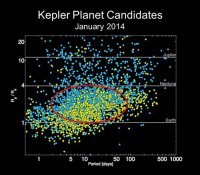
Of the Kepler spacecraft’s impressive haul (3,538 exoplanet candidates as of November 2013), roughly three-quarters of them scale between Earth and Neptune, which is four times the size of Earth.

At the January 2014 meeting of the American Astronomical Society, Geoff Marcy (University of California, Berkeley) announced the results of four years’ worth of these ground-based observations, which followed up on 22 stars with 42 exoplanets. The team measured masses for 16 planets, and rough guesses (in technical terms, 1-2σ measurements) or upper limits for the rest. Another team led by Yoram Lithwick (Northwestern University) took a different approach. If two or more planets orbit the same star, the planets will gravitationally tug each other, tweaking the timing of each transit. Using this method, Lithwick and Hadden measured the masses of another 58 super-Earths.

Both Marcy and Lithwick found the same thing: up to somewhere between 1.5 to 2 Earth radii, the bigger the planet, the denser it becomes. That’s about what you would expect for rocky planets. But theory says that at a certain point, gravitational compression wins out - add more mass and it just compresses further - so rocky planets should never get any bigger than about twice Earth’s size. And that’s exactly what Marcy and Lithwick find: planets bigger than about twice the size of Earth actually get fluffier as they grow. These bigger-but-less-dense planets are probably adding an extended atmosphere of mostly hydrogen and helium around a rocky core.

David Kipping (Harvard-Smithsonian Center for Astrophysics) announced the discovery of KOI-314C, the first Earth-mass planet that is surprisingly nothing like Earth. Its radius is 60% larger than Earth’s, so in classic mini-Neptune style, it too probably has a rocky core surrounded by gas.

(1) Chart of Kepler planet candidates as of January 2014.

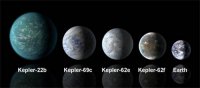
(2) Relative sizes of habitable-zone planets discovered by the Kepler spacecraft, shown alongside Earth.


Image Credit: NASA Ames/JPL-Caltech
 

Anhänge

  • kepler-pcs-ln.jpg
    kepler-pcs-ln.jpg
    96,9 KB · Aufrufe: 1.350
  • Kepler_SuperEarth_compariso.jpg
    Kepler_SuperEarth_compariso.jpg
    44 KB · Aufrufe: 1.631
Re: Kepler Update

Tatooine war der fiktive Prototyp eines Planeten mit einer doppelten Sonne aus den Star Wars Filmen von George Lucas. Seitdem sind bislang 17 solcher zirkumbinärer Planeten aufgespürt worden und es werden laufend mehr davon. Dazu gehören die folgenden von Kepler aufgespürten Exemplare:

Kepler-34b

Kepler-35b

Kepler-38b

Kepler-47b,c

Kepler-64b

Kepler-413b

Solche exotischen Systeme, bei denen ein oder sogar mehrere Planeten einen Doppelstern umlaufen, sind also mittlerweile nicht mehr fiktiv. Das Verständnis darüber, wie solche Systeme aus einer protoplanetaren Gas- und Staubscheibe entstehen konnten, ist allerdings noch in den Kinderschuhen. Jetzt gibt es eine Simulationsstudie, die sich mit dieser Frage befasst:

S. Lines et al.: Forming Circumbinary Planets: N-body Simulations of Kepler-34

Ein anders Papier behandelt Kepler-413b, bei dem die Bahnebene des Planeten gegenüber der Bahnebene des Doppelsterns verkippt ist. Dadurch kommt es zu einer Präzession der Bahnknoten und einer ungleichmäßigen Abfolge von Transitereignissen:

V.B. Kostov et al.: Kepler-413b: a slightly misaligned, Neptune-size transiting circumbinary planet

Siehe dazu auch diesen Artikel bei S&T:

Shedding Twice the Light on Circumbinary Systems

Copyright note: This image is a screenshot from a copyrighted film, and the copyright for it is most likely owned by the studio which produced the film, and possibly also by any actors appearing in the screenshot. It is believed that the use of a limited number of web-resolution screenshots qualifies as fair use under United States copyright law. Any other uses of this image, on Wikipedia or elsewhere, may be copyright infringement.
 

Anhänge

  • SW_binary_sunset.jpg
    SW_binary_sunset.jpg
    30,3 KB · Aufrufe: 1.027
Re: Kepler Update

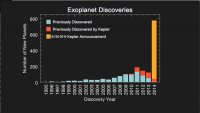
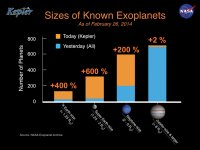
715 neue Planeten auf einen Streich:

NASA Press Release - NASA's Kepler Mission Announces a Planet Bonanza, 715 New Worlds

NASA's Kepler mission announced Wednesday the discovery of 715 new planets. These newly-verified worlds orbit 305 stars, revealing multiple-planet systems much like our own solar system.

The research team used a technique called verification by multiplicity, which relies in part on the logic of probability. Kepler observes 150,000 stars, and has found a few thousand of those to have planet candidates. If the candidates were randomly distributed among Kepler's stars, only a handful would have more than one planet candidate. However, Kepler observed hundreds of stars that have multiple planet candidates. Through a careful study of this sample, these 715 new planets were verified.

This latest discovery brings the confirmed count of planets outside our solar system to nearly 1,700.


NASA Media Briefing - Presentation (27 MB pdf)

space.com - Population of Known Alien Planets Nearly Doubles as NASA Discovers 715 New Worlds

BBC News - Kepler telescope bags huge haul of planets

Scientific Papers:

Lissauer et al. (14 MB pdf)

Rowe et al. (8 MB pdf)

List of exoplanets discovered using the Kepler spacecraft

Image Credit: (1) NASA Ames/W Stenzel, (2) NASA Ames/SETI/J Rowe
 

Anhänge

  • knownexoplanets.jpg
    knownexoplanets.jpg
    89,3 KB · Aufrufe: 989
  • Kepler-Histogram-20140226.jpg
    Kepler-Histogram-20140226.jpg
    55,8 KB · Aufrufe: 1.023
Status
Es sind keine weiteren Antworten möglich.
Zurück
Oben