P_E_T_E_R
Aktives Mitglied
Kepler 16b - Doppelsternplanet
Bisher gab's das nur in Science Fiction: ein Planet, der um eine doppelte Sonne kreist. Jetzt wurde so etwas tatsächlich gefunden:
NASA News NASA's Kepler Discovery Confirms First Planet Orbiting Two Stars
MOFFETT FIELD, Calif. -- The existence of a world with a double sunset, as portrayed in the film Star Wars more than 30 years ago, is now scientific fact. NASA's Kepler mission has made the first unambiguous detection of a circumbinary planet -- a planet orbiting two stars -- 200 light-years from Earth.
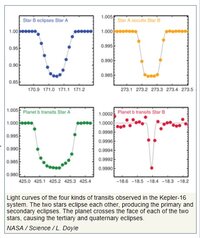
Unlike Star Wars’ Tatooine, the planet is cold, gaseous and not thought to harbor life, but its discovery demonstrates the diversity of planets in our galaxy. Previous research has hinted at the existence of circumbinary planets, but clear confirmation proved elusive. Kepler detected such a planet, known as Kepler-16b, by observing transits, where the brightness of a parent star dims from the planet crossing in front of it.
Science News "On Kepler-16b, shadows come in pairs"
LA Times Scientists find planet orbiting two suns like in 'Star Wars'
Spiegel Ferner Planet hat zwei Sonnen
Kepler 16
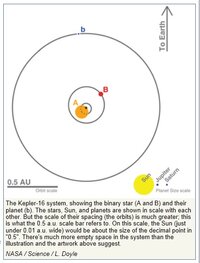
Kepler-16 is a binary star system targeted by the Kepler spacecraft. It is host to one known planet: the Saturn-sized Kepler-16b. The stars are separated by 0.22 AU, and complete an orbit around a common center of mass every 41 days. Both stars are smaller than the Sun; the primary is a class K orange dwarf, and the secondary is a class M red dwarf.
Keplewr 16b
Kepler-16b is an extrasolar planet. It is a Saturn-mass planet consisting of half rock and half gas, and it orbits around a binary star, Kepler-16, with a period of 229 days. This is the first observationally confirmed example of a circumbinary planet.
Bisher gab's das nur in Science Fiction: ein Planet, der um eine doppelte Sonne kreist. Jetzt wurde so etwas tatsächlich gefunden:
NASA News NASA's Kepler Discovery Confirms First Planet Orbiting Two Stars
MOFFETT FIELD, Calif. -- The existence of a world with a double sunset, as portrayed in the film Star Wars more than 30 years ago, is now scientific fact. NASA's Kepler mission has made the first unambiguous detection of a circumbinary planet -- a planet orbiting two stars -- 200 light-years from Earth.
Unlike Star Wars’ Tatooine, the planet is cold, gaseous and not thought to harbor life, but its discovery demonstrates the diversity of planets in our galaxy. Previous research has hinted at the existence of circumbinary planets, but clear confirmation proved elusive. Kepler detected such a planet, known as Kepler-16b, by observing transits, where the brightness of a parent star dims from the planet crossing in front of it.
Science News "On Kepler-16b, shadows come in pairs"
LA Times Scientists find planet orbiting two suns like in 'Star Wars'
Spiegel Ferner Planet hat zwei Sonnen
Kepler 16
Kepler-16 is a binary star system targeted by the Kepler spacecraft. It is host to one known planet: the Saturn-sized Kepler-16b. The stars are separated by 0.22 AU, and complete an orbit around a common center of mass every 41 days. Both stars are smaller than the Sun; the primary is a class K orange dwarf, and the secondary is a class M red dwarf.
Keplewr 16b
Kepler-16b is an extrasolar planet. It is a Saturn-mass planet consisting of half rock and half gas, and it orbits around a binary star, Kepler-16, with a period of 229 days. This is the first observationally confirmed example of a circumbinary planet.